Mon, 21 Sep 2026 06:55:00 PDT

("#ShanahTovah " to all our
#Jewish friends on this #YomKippur High Holy Day!) =========
September 20 Sundown - September 21 Nightfall, 2026: -- Yom
Kippur, also known as The Day Of Atonement, is observed, the
holiest day of the year in Judaism. Its central themes are
atonement and repentance. Jews traditionally observe this holy day
with an approximate 25-hour period of fasting and intensive
prayer, often spending most of the day in synagogue services. Yom
Kippur is "the tenth day of [the] seventh month"
(Tishrei) and is regarded as the "Sabbath of Sabbaths".
Rosh Hashanah (referred to in the Torah as Yom Teruah) is the
first day of that month according to the Hebrew calendar. On this
day forgiveness of sins is also asked of God. Yom Kippur completes
the annual period known in Judaism as the High Holy Days or Yamim
Nora'im ("Days of Awe") that commences with Rosh
Hashanah. #YomKippur #DayOfAtonement #ShanahTovah #HighHolyDays
#Judaism #JewishHolidays #MP4 #VideoDownload #DVD
https://store.earthstation1.com/teinjearkofc.html
Mon, 21 Sep 2026 06:55:00 PDT

September 21: National Pecan Cookie Day:
-- This delicious treat can be eaten at all times of the day any
day! If pecans are your thing, you might also want to look out for
April 14, which is National Pecan Day. National Pecan Cookie Day
marks the creation of one of the most delightful cookies in the
world. The observance calls attention to this sweet treat that is
sure to leave you craving more. It also serves the purpose of
creating awareness about pecan cookies and providing an
opportunity for those who already love them to celebrate their
yummy taste. The word 'pecan' has Algonquian origins translated as
'a nut requiring a stone to crack.' The pecan is part of the
hickory family, it is found mainly in the central and southern
regions of the United States. Historical records from the 1500s
claim that Europeans first encountered pecans in Mexico, including
several southern states of the United States. Pecans were
immediately accepted and gained popularity when American colonists
came across them and tasted the delicious flavor. Pecans have
enjoyed time in the limelight. It first entered print in 1773, and
former U.S. President George Washington was said to have received
the nuts from Thomas Jefferson and planted several pecan trees.
Pecans soon became a symbol of the American South, setting the
stage for the creation of the widely popular pecan pie. Besides
being delicious to eat, pecans have several vital health benefits.
They have a fair amount of protein, fiber, iron, vitamin B, and
magnesium. There's nothing better than a delicious treat that fits
right into a healthy diet. This observance presents the
opportunity for foodies to enjoy these delightful cookies and
share them with family and friends. One excellent way to mark
National Pecan Cookie Day is to eat a fresh homemade batch
straight out of the oven! A cool glass of milk will work wonders
as a pairing. There happen to be tons of recipes out there for
creating firm or soft versions of the cookie. Just thinking about
the sugary sweetness of the toasted nuts melting on your tongue is
enough to send you reeling. Dust off grandma's cookbook and hunt
out that crazy recipe, it's time to whip up a tasty batch of pecan
cookies. Whether it's the chewy or dunking type, you're sure to
have a swell time.
https://store.earthstation1.com/race-cartoons-dvd-dual-layer-all-regions.html
Mon, 21 Sep 2026 06:55:00 PDT

September 21: National Cat & Dog Gut
Health Awareness Day: -- Created to increase awareness about gut
health and its importance for our pets' overall health. Does your
cat have beautiful, soft fur? Is your dog a healthy weight and has
firm, regular poop? You can thank their gut microbiome. Like
humans, cats and dogs have a complex community of trillions of
microorganisms living in their gut. Collectively called the gut
microbiome, this community supports almost every aspect of your
pet's health - helping with digestion, protecting against disease,
maintaining healthy GI function, and so much more. Disruption of
the gut microbiome - due to factors like diet, age, disease, and
certain medications - can cause some of these functions to stop
working. This can lead to uncomfortable symptoms for your pet,
like itchy skin, diarrhea, constipation, obesity, and even
behavioral issues. Dutch businessman and self-taught scientist
Antonie van Leeuwenhoek discovered bacteria in the late 17th
century, using powerful, single-lens microscopes he made himself.
Leeuwenhoek considered these "animalcules," as he termed
them, to be the most marvelous of all of his discoveries.
Leeuwenhoek's work opened the door for studies on the
relationships between bacteria and human health and disease. In
1842, Edinburgh surgeon John Goodsir made one of the first
descriptions of gastrointestinal bacteria, discovering a bacterium
he named Sarcina ventriculi from the stomach and implicating it as
a cause of vomiting. Also around this time, French chemist and
microbiologist Louis Pasteur postulated that microorganisms known
as pathogens or "germs" can lead to disease. A few
decades later, German physician and microbiologist Robert Koch
extended these earlier studies with the development of a set of
scientific rules termed "Koch's postulates." Based on
the isolation and culture of bacteria from people or animals with
the disease, and subsequent inoculation of healthy individuals
with the isolated organism to reproduce the disorder, Koch's
postulates provided unequivocal links between specific pathogens
and disease. The relationship between gut bacteria and health and
disease was further advanced by the German pediatrician, Theodor
Escherich in the late 1880s. Escherich theorized that
microorganisms living in the intestine, including Escherichia coli
(E. coli), which he discovered, were crucial to comprehending the
physiological and pathophysiological processes of the gut. Almost
a century later (in the 1970s), Carl Woese and George Fox revealed
the deep evolutionary history shared by all living organisms using
molecular sequencing techniques. This led to a new understanding
of animal biology, reflecting the strong interdependencies between
complex multicellular organisms, their associated commensal or
"friendly" microorganisms, and the impact of these
relationships on animal physiology. To further our understanding
of these interdependent relationships, the National Institutes of
Health (NIH) Human Microbiome Project (HMP), initiated in 2007,
examined microbial communities from 300 healthy human individuals
across several different body sites. The complexity of microbial
communities at each body site was examined using molecular
sequencing techniques, facilitating investigations on the
existence of a core healthy microbiota (also referred to as the
microbiome) across individuals. Perturbations disrupting the
balance of a healthy gut microbiome are considered to be
indicative of dysbiosis. In studies of human health, many diseases
have been reported to be associated with dysbiosis of the gut
microbiome, including inflammatory bowel disease, diabetes (types
1 and 2), multiple sclerosis, autism, allergies, asthma, and
cancer. Ongoing research has also shown that the gut microbiome
plays a significant role in our pets' overall health and
well-being. AnimalBiome began testing pet microbiomes in 2015 and,
using molecular sequencing techniques, has become the world's
leading pet microbiome research company. They have tested
thousands of cats and dogs and boast the world's most extensive
collection of pet microbiome samples, with products and at-home
testing kits recommended by more than 1,000 veterinarians.
AnimalBiome's 2022 State of the Gut_ Report showed that 58% of
pets experience at least one symptom, every month, that could be
related to an imbalance in their gut microbiome. So it's more
important than ever for pet parents to understand how the bacteria
in the gut influence an animal's digestion, immune functions, skin
health, longevity, and other aspects of their well-being. By
learning how to support and improve your cat's or dog's gut
microbiome, you can help your pet stay healthy and happy for a
long time.
https://store.earthstation1.com/super-sense--animal-perception-tv-series-dvd-mp4-download-usb-driv4.html
Mon, 21 Sep 2026 06:55:00 PDT

September 21: Student's Day (Argentina):
-- A special occasion that spotlights young people's energy and
creativity. Students across the country gather to celebrate their
shared experiences and the arrival of spring. This day transforms
public spaces, especially parks, into lively spots filled with
music, sports, and laughter. Groups of friends enjoy picnics, play
soccer, and simply relax under the blooming trees, making it a
celebration of life, growth, and new beginnings. More than just a
day of relaxation, it symbolizes the important role that students
play in shaping the future. It is not just about taking a break
from studies but about fostering a sense of community and joy. The
day encourages camaraderie and lets students celebrate their
achievements and look forward to what lies ahead. From the
smallest towns to the largest cities, Student's Day connects
people of all ages with the spirit of youth and renewal. Student's
Day in Argentina has a history deeply tied to education and the
celebration of youth. It began in 1902, when the remains of
Domingo Faustino Sarmiento, a key figure in shaping Argentina's
education system, were repatriated to the country. Sarmiento's
strong push for accessible education earned him the title "Father
of the Classroom," making this day not just a celebration of
students but also a nod to his contributions. While it's now
linked with the arrival of spring and lively gatherings, its
origin was rooted in honoring Sarmiento's work for education. Over
time, this connection evolved into a nationwide celebration of
student life, complete with parades, festivals, and sports events.
Schools and universities across Argentina embraced it as a way to
recognize the role students play in the nation's future.
https://store.earthstation1.com/teenagers-classic-youth-social-guidance-films-dvd-set-2-disc2.html
Mon, 21 Sep 2026 06:55:00 PDT

September 21: Earth, Wind And Fire
Appreciation Day: -- "Do you remember_ the 21st night of
September?" If you do, then you're not alone! This catchy
little phrase comes from the pop song titled September, a
delightful little tune that makes everyone who hears it want to
sing, dance - and remember - on this particular day! Released in
1978 by the Chicago-based band Earth, Wind and Fire, the song that
is celebrated on this day was a track on the band's "Best Of"
album. The memorable melody and easy lyrics ("Ba-dee-ya",
anyone?) brought to its listeners a light-hearted celebration of
love, happiness and joy. Today, more than 45 years later, the song
continues to be enjoyed not only by folks who remember it
originally, but by a new era of young people. The song has been
recorded as a cover by dozens of musicians, not the least famous
of whom is Taylor Swift. In 2018, September was added to the
Library of Congress National Recording Registry naming it among a
list of songs that are "culturally, historically or
aesthetically important." Earth, Wind and Fire Appreciation
Day started somewhere in the late twenty-teens, and the City of
Los Angeles officially declared the day in 2019. Since then, it
has taken off as an internet and social media sensation!
https://store.earthstation1.com/rock-amp-roll-an-unruly-history-10-part-tv-series-mp4-video-download-104.html
Mon, 21 Sep 2026 06:55:00 PDT

( #JCKaelin here: please pay especial
attention to my corrections listed below to the conventional
wisdom regarding the longevity of wooden utility poles - indeed, I
have never in all my life throughout all of the state of New
Jersey seen a utility pole replaced except in instances of damage
by automobile accidents, lightning strikes or living trees falling
on them or their respective wires during storms, never due to
decay -- indeed, I have film footage, shot by none other than
Thomas A Edison just two blocks from here , which I uploaded here
at
https://www.mediaoutletemailings.com/DLs/'!Miscella/BurningOfTheStandardOilCompanyTanks-BayonneNJ1900-07-05.mp4
for you to see, that show *the very same wooden utility poles
filmed then, which are still used now to carry all our power and
telecommunications lines throughout this far more developed and
populated area of Bayonne 125 years later!* :) ) =========
September 21: Utility Pole Appreciation Day (Telegraph Pole
Appreciation Day) (United Kingdom): -- A "telegraph pole"
is the British way of referring to a utility pole. A utility pole
is a column or post which is usually made out of wood to support
overhead power lines and a variety of other public utilities, such
as electrical cables, fiber optic cables, and other such equipment
as transformers, street lights, etc. A telegraph pole, or utility
pole , can also alternatively be referred to as a transmission
pole, a telephone pole, a telecommunications pole, a power pole, a
hydro pole or a telegraph post -- all more or less due to its
current purpose or local historical referemce. Most utility poles
are made of wood, pressure-treated with some type of preservative
for protection against rot, fungi and insects. Southern yellow
pine is the most widely used species in the United States;
however, many species of long straight trees are used to make
utility poles, including Douglas fir, jack pine, lodgepole pine,
western red cedar, and Pacific silver fir. Traditionally, the
preservative used was creosote, but due to environmental concerns,
alternatives such as pentachlorophenol, copper naphthenate and
borates are becoming widespread in the United States. In the
United States, standards for wood preservative materials and wood
preservation processes, along with test criteria, are set by ANSI,
ASTM, and American Wood Protection Association (AWPA)
specifications. Although it is claimed that the decay rate of wood
poles give them a life of approximately 25 to 50 years, depending
on climate and soil conditions, #JCKaelin has Edison newsreel
video evidential proof that the very same wooden poles still in
use today in the environs of MediaOutlet and EarthStation1 were
standing in the same positions fully fulfilling their designated
purpose right up till the present day *for over 125 years, and
they were old back then, too*. In any event, wooden poles do
require regular inspection and remedial preservative treatments.
Woodpecker damage to wood poles is claimed to be the most
significant cause of pole deterioration in the U.S. The first
utility poles were introduced in 1843 by William Fothergill Cooke,
who pioneered the telegraph. First used on a line along the Great
Western Railway, these poles were then incorporated into regular
use by the mid-19th century in America with telegraph systems,
beginning with Samuel Morse, who attempted to bury a line between
Baltimore, Maryland, and Washington, D.C. but eventually moved it
overhead when his system proved faulty. Today, underground
distribution lines are increasingly used as an alternative to
utility poles, due to poles' perceived ugliness, as well as safety
concerns in areas with large amounts of snow or ice buildup. Early
installations of poles involved treatment with tar, but were later
treated with creosote or copper sulfate as the preservative
instead as the tar treatment was found to only last up to about
seven years. In Eastern Europe, Russia, and some third-world
countries, it is still common to find utility poles carrying bare
communication wires mounted on insulators not only along railway
lines but along roads and sometimes even in urban areas. In the
United States, electricity is predominantly carried on unprotected
aluminum conductors which are wound around solid steel cores and
attached to rated insulators made out of glass, ceramic, or poly.
Telephone, Community Access Television, and fiber optic cables are
generally affixed directly to the pole with no insulators.
https://store.earthstation1.com/lost-ernie-kovacs-dual-layer-dvd-old-time-tv-shows.html
Mon, 21 Sep 2026 06:55:00 PDT

September 21: Escapology Day: --
September 21, 1912: Harry Houdini first publicly performs his
famous Water Torture Cell escape in Berlin, Germany, a feat of
magic that was what made master illusionist and magician Harry
Houdini a household name. Ask any magician, street performer, or
daredevil - escaping restraints is not for the faint-hearted - and
this is what makes so special! Escapology is defined as the art of
escaping any and all restraints, including straitjackets,
handcuffs, and cages. Escaping from restraints and confined spaces
is a handy tool many performers have in their arsenal, which they
use to utterly captivate their audience. But, this is in no way a
new skill. Street performers, magicians, and others have been
using this skill for many years. In the early days of performing
arts, escapology was not an act in itself. Instead, performers
used it as a part of their original act to sneakily create
illusions, disappear and reappear in another place, and convince
people they had magical powers. A sibling pair of American
magicians, publicly called the Davenport brothers, was so skilled
at getting out of rope ties that they managed to convince people
they had supernatural powers. This claim was later debunked by
other illusionists, who not only worked out how the Davenports
performed their acts but also re-created them for the audience.
However, these recreations were still not the elaborate and
awe-inducing escape acts of today, but merely replicated the
magicians' tricks. And then, out of the woodwork came a performer
like no other, one who would make escaping into an art form that
is still celebrated today. When Harry Houdini began his career, he
initially only focused on sleight-of-hands tricks and magic. When
Houdini began experimenting with escape acts after a
not-as-glittering career as a magician, little did he know that it
would catapult him into instant stardom. He quickly became a
breakout escape artist, performing his acts at major entertainment
houses around the world. Houdini's mastery of breaking out of
restraints manifested itself in world-famous acts like
Metamorphosis and the Chinese Water Torture Cell, the latter of
which inspired celebrations for Escapology Day. In this act,
Houdini had to escape a locked tank of water, in which he was hung
upside down, and his feet were weighed down with heavy stocks.
Houdini went on to perform this particular feat multiple times
over the years, and his acts have inspired and challenged escape
artists for generations now.
https://store.earthstation1.com/clive-james39-fame-in-the-20th-century-tv-series-dvd-set-mp4-usb-39204.html
Mon, 21 Sep 2026 06:55:00 PDT

September 21: Get Ready Day: -- Prepare
yourself! Established in 2006 by the American Public Health
Association (APHA), the goal of Get Ready Day is to arm
individuals, families, and communities with knowledge that will
help them cope with crises such as natural disasters, infectious
diseases and pandemic illnesses. To stay prepared, attend a Get
Ready Day event in your area and get yourself - and your loved
ones - ready to survive any emergency situation that may come your
way. You could save a life, maybe even your own! Need proof? Check
out to the next two natural disaster listings for intense natural
disasters that occured on this date in history: =========
September 21, 1938: The Great Hurricane of 1938 makes landfall on
Long Island in New York. The death toll is estimated at 500-700
people. The 1938 New England Hurricane (also referred to as the
Great New England Hurricane and Long Island Express) was one of
the deadliest and most destructive tropical cyclones to strike
Long Island, New York and New England. The storm formed near the
coast of Africa on September 9, becoming a Category 5 hurricane on
the Saffir-Simpson Hurricane Scale before making landfall as a
Category 3 hurricane on Long Island on September 21. It is
estimated that the hurricane killed 682 people, damaged or
destroyed more than 57,000 homes, and caused property losses
estimated at 306M USD (4.7B in 2017). Damaged trees and buildings
were still seen in the affected areas as late as 1951. It remains
the most powerful and deadliest hurricane in recorded New England
history, eclipsed in landfall intensity perhaps only by the Great
Colonial Hurricane of 1635. ========= September 21, 1934: The 1934
Muroto Typhoon hits western Honshu, Japan, a large and violent
typhoon causing tremendous devastation in Japan, regarded as the
"second-greatest catastrophe of modern Japan",
ultimately killing more than three thousand people. Dubbed the
Muroto typhoon (Japanese: Muroto Taifu), the system was first
identified on September 13 over the western Federated States of
Micronesia. Moving generally northwest, it eventually brushed the
Ryukyu Islands on September 20. Turning northeast, the typhoon
accelerated and struck Shikoku and southern Honshu the following
morning. It made landfalls in Muroto, Kaifu, Awaji Island, and
Kobe. A pressure of 911.9 hPa (26.93 inHg) was observed in Muroto,
making the typhoon the strongest ever recorded to impact Japan at
the time. This value was also the lowest land-based pressure
reading in the world on record at the time; however, it was
surpassed the following year during the 1935 Labor Day hurricane.
After clearing Japan, the now extratropical storm traveled east
and weakened. Turning north by September 24, the system deepened
and impacted the Aleutian Islands; it was last noted the following
day over western Alaska. The storm left parts of Osaka in ruins.
Tens of thousands of structures were damaged or destroyed, leaving
approximately 200,000 people homeless. Among the 3,066 people
killed were 421 children and teachers who perished when their
flimsy schools were destroyed. This ranked it, at the time, as the
deadliest typhoon in Japanese history. In addition to the
fatalities, 13,184 people were injured. Total damage exceeded 300
million 1934 USD (5.6 billion 2018 USD).
https://store.earthstation1.com/natural-disasters-dvd-earthquakes-floods-tornados-hurricanes.html
Mon, 21 Sep 2026 06:55:00 PDT

September 21: World Gratitude Day: --
This day aims to remind us of the importance of expressing
gestures of thanks and appreciation. Understandably, sometimes we
can get caught up in our busy lives and neglect to show how
grateful we are for the people around us. Many people believe that
once you commit a simple act of kindness for someone, you don't
need to manifest that kind of kindness repeatedly. But if you do,
it makes the world a better place. After all, it's your world, and
you have to live in it! Appreciation is a worldwide practice today
and a personal one that we can all use to improve our lives - but
it goes back to 1965. World Gratitude Day was invented by Sri
Chinmoy, a spiritual leader and meditation teacher. It was
conceived at a Thanksgiving dinner in the United Nations'
meditation room. At the dinner, Chinmoy suggested the idea of a
global holiday of gratitude. Each person at the dinner pledged to
hold an event in their home country every year on that holiday,
and they all spent the rest of the evening discussing how they
might spread the word about this new holiday. The following year,
in 1966, many countries observed the first annual World Gratitude
Day on September 21, and the day has been celebrated annually ever
since. In 1977, the Spiritual League, a group of Chinmoy's
followers who ran the meditation room at his New York
headquarters, requested that a resolution be passed recognizing
World Gratitude Day. Representatives from the Headquarters were in
attendance to honor Chinmoy during the special ceremony.
https://store.earthstation1.com/cold-war-capitalism-dvd-in-our-hands-propaganda-films.html
Mon, 21 Sep 2026 06:55:00 PDT

September 21: World Alzheimer's Day: --
On this day, the world concentrates its efforts on creating
awareness of Alzheimer's disease. The disease is among the most
prevalent forms of dementia; a set of disorders that disrupt
mental function. World Alzheimer's Day is the perfect opportunity
for us to raise our voices and find new ways of fighting the
disease's effects. Alzheimer's is a form of dementia that affects
memory and impairs daily function. It is responsible for somewhere
between 60% and 80% of dementia cases. Alois Alzheimer, a German
psychiatrist, was the first to identify the disease while treating
a German woman in 1901. The disease was named after him. The
condition is often regarded as a family disease due to the impact
it has on those closest to the victim. Alzheimer's ranks among the
leading causes of death in the United States. There are no
prevention measures and it has no cure, even the progression of
the disease cannot be slowed. Founded in 1984, Alzheimer's Disease
International (ADI) is charged with supporting victims and
conducting outreach to educate people and expedite related
policies. In 1994, ADI introduced World Alzheimer's Day in
Edinburgh during their annual conference on September 21 to mark
their 10th anniversary. ADI coordinates World Alzheimer's Day and
World Alzheimer's Month across the globe, working with member
organizations and associations to organize events and create
awareness. The first 'World Alzheimer Report' was launched in 2009
on World Alzheimer's Day and yearly reports have been issued every
year since. Although the impact of the observance is spreading,
the information gap and stigmatization concerning dementia remains
an issue. Many people see the disease as a natural part of the
aging process. Granted, advancement in age is among the major
causes of Alzheimer's disease, but it isn't completely an elderly
disease. There are about 200,000 people under the age of 65
struggling with Alzheimer's in the United States alone. To mark
this observance, concerned individuals and organizations can
participate by creating awareness and reaching out to their
nation's Alzheimer's association.
https://store.earthstation1.com/aaron-copland-a-self-portrait-dvd.html
Mon, 21 Sep 2026 06:55:00 PDT

September 21: National New York Day: -- A
day that honors The Empire State, the 11th state to join the Union
-- and we think the state is entitled to some amazing occades!
From the timeless halls of Ellis Island to the epic beauty of
Niagara Falls and breathtaking Adirondacks, New York is infused
with grand vistas and endless historical paths to retrace. With
New York City as the epitome of a melting pot long before the term
was coined, the state is full of inspiration for artists, sparks
intelligent debate and philosophical discussion. The Lenape people
populated the land now known as New York. They're also known as
the Delaware Indians. Their settlements also spread across New
Jersey, Pennsylvania, and parts of Delaware and Connecticut.
However, the Dutch were the first Europeans to settle the area and
named it New Netherland. Settlements and trading posts developed
up and down the Hudson River. Albany, the state capital, was once
called Beverwijck and the center of the fur trade. In 1624, the
Dutch established a settlement on Nutten Island named New
Amsterdam. Two years later, they would move to Manhattan Island,
and the colony flourished. Over time, the settlement exchanged
hands between the Dutch and British several times, each without
bloodshed. The first exchange, in 1664, would name it New York.
After declaring independence, the colonies later created the
Articles of Confederation. Soon they discovered a stronger
governing document was needed. While New York sent three delegates
to the Constitutional Convention in 1787, only Alexander Hamilton
remained to sign the final document. A Federalist, Hamilton held
strong opinions that could potentially influence the framing of
the young nation's new governing document. For one, Hamilton
supported a life term of service for the President!
https://store.earthstation1.com/new-york-city-history-videos-3-dvd-se3.html
Mon, 21 Sep 2026 06:55:00 PDT

September 21: Malta Independence Day: --
Commemorates the country's September 21, 1964 independence from a
United Kingdom grateful for its support and service to the British
Empire over the centuries and during World War II in particular -
and in honor of the cords of affection that bind the two nations
together, Malta chose to remain in the Commonwealth and keep the
British Monarch. Ten years later, Malta declared itself as a
republic with the president serving as the Head of State. Today,
Malta elects its representatives through democratic elections,
with its parliament of Malta modeled on the Westminster
parliament. An archipelago nation in the European Union, Malta has
been under the rule of several foreign powers before it became
independent from Britain. The British foothold in Malta, which
began in 1813, was the longest in Maltese history. Rrom the year
of its independence, Malta has been a part of the United Nations,
and in 2004 the nation joined the European Union. Malta has been
long inhabited by humans. Records show that human settlements
arrived in Malta as early as 5900 B.C. Since it is centrally
located in the Mediterranean Sea, the nation has enjoyed a
strategic privilege in trade and commerce, which also made it a
prized possession for foreign conquerors. From the ancient
civilizations of Phoenicians and Carthaginians to the modern
conquerors like the French and British, almost every ruling
foreign power has desired Malta to build naval ports and
strengthen its trade routes. All of these foreign powers have
influenced the culture of Malta in some way or another and today
the nation is a melting pot of its history. The British arrived on
the shores of Malta in 1813. Initially, it served as a way station
for ships and the headquarters for the British Mediterranean
Fleet. However, with the outbreak of the Second World War, Malta
became an Allied base to oversee operations in North Africa and
the Mediterranean. It was during this time that the nation gained
some political traction and there was an invigorated interest
among the locals to establish self-rule. The treaty that declared
Malta an independent country was signed in 1964 but Queen
Elizabeth II continued to serve as the nation's monarch. She
occupied the position of Head of State with a governor-general
exercising authority on her behalf. Ten years later, Malta
declared itself as a republic with the president serving as the
Head of State. Today, Malta elects its representatives through
democratic elections. The parliament of Malta is modeled on the
Westminster parliament.
https://store.earthstation1.com/battleline-wwii-tv-documentary-series-5-dual-layer-dvd5.html
Mon, 21 Sep 2026 06:55:00 PDT

September 21: Armenian Independence Day:
-- An annual holiday that celebrates the independence of the
country. On this day Armenia officially became independent from
the USSR with the adoption of the Declaration of State
Sovereignty. Armenia is a federal republic with a presidential
system governed by a constitution. Formally known as the Republic
of Armenia, the country is home to 2.9 million inhabitants and is
bordered by Turkey, Georgia, Iran, and Azerbaijan. The country
consists of mountainous terrain, with vast valleys and small
plains. The capital city is named Yerevan and is found on the
foothills of Mount Ararat. This day has meaning in Armenian
culture as it represents the end of years of struggle for a free
country. After the fall of the Soviet Union, many people in the
country were concerned that they would lose their freedom and be
forced back under Russian rule. In the late 1980s, there was
growing dissent in Armenia against Soviet rule. On August 23,
1990, the Supreme Council of Armenia decreed that the Soviet
Armenian SSR should move out and free the Republic of Armenia.
Since Armenia refused to join the New Union Treaty, which it
believed would render it a part of Russia, an attempted coup
d'etat took place on August 19, 1991, but failed. In response, on
September 21, 1991, a referendum was held with over 90% voting in
favor of independence. In November 1991, Levon Ter-Petrosyan was
elected the first president of Armenia. A few months later, in
December 1991, Armenia joined the Commonwealth of Independent
States (CIS). Finally, on December 26, 1991, in connection with
the dissolution of the USSR Armenia gained independence. It is the
second declaration of independence in modern Armenian history. The
first took place on May 28, 1918, when the First Republic of
Armenia was established as a nation-state. This nation-state in
late 1920, was partitioned by the Russian Soviet Federative
Socialist Republic and Turkish Nationalist forces.
https://store.earthstation1.com/the-second-russian-revolution-6-dvd-set-complete-tv-serie6.html
Mon, 21 Sep 2026 06:55:00 PDT

September 21: The International Day Of
Peace (World Peace Day): -- A day devoted to strengthening the
ideals of peace, both within and among all nations and peoples. At
a time when war and violence often monopolize our news cycles, the
International Day of Peace is an inspiring reminder of what we can
create together. Peace. Let's give it a chance! In 1981, the
United Nations General Assembly declared the third Tuesday of
September as International Day of Peace. This day coincided with
the opening day of the annual sessions of the General Assembly.
The purpose of the day was and still remains, to strengthen the
ideals of peace around the world. Two decades after establishing
this day of observance, in 2001, the assembly moved the date to be
observed annually on September 21. So, beginning in 2002,
September 21 marks not only a time to discuss how to promote and
maintain peace among all peoples but also a 24-hour period of
global ceasefire and non-violence for groups in active combat.
Peace is possible. Throughout history, most societies have lived
in peace most of the time. Today, we are much less likely to die
in war than our parents or grandparents. Since the establishment
of the United Nations and the creation of the Charter of the
United Nations, governments are obligated not to use force against
others unless they are acting in self-defense or have been
authorized by the UN Security Council to proceed. Life is better
in a world where peace exists and, today, we look to those who
have been peacemakers and peacekeepers to learn what we can each
do individually to make the world a more peaceful place.
https://store.earthstation1.com/united-nations-documentaries-set-dvd-mp4-download-usb-driv4.html
Mon, 21 Sep 2026 06:55:00 PDT

September 21: National Opioid Awareness
Day: -- A day to create awareness about the effects of opioid
overdose and reduce the stigma associated with it. Its purpose is
to raise awareness of overdoses, reduce the stigma of drug-related
deaths, and acknowledge the grief felt by families and friends.
The holiday is the American version of International Overdose
Awareness Day, which was initiated in 2001 in Australia by S. J.
Finn. The movement is necessitated by the problem of opioid use in
the U.S. Opioids are a diverse class of strong, addictive, and
considerably inexpensive drugs, which include opiates and
fentanyl. Conventionally, opioids have been prescribed as pain
medication, as they are capable of treating acute pain but are
less effective for treating chronic pain. Clinical guidelines
state that opioids should be used only as a last resort for
chronic pain in the absence of safer alternatives, as the risks of
opioids often outweigh the benefits. The opioid epidemic in the
U.S. is due to the ongoing overuse of opioid medications, both
from medical prescriptions and illegal sources. According to the
Centers for Disease Control and Prevention, this extensive overuse
of opioid substances began in the U.S. in the late 1990s. This was
a time when opioid prescriptions for pain management escalated and
resulted in a rise in the overall use of opioids in the following
years. Most Americans who use prescription opioids for pain
management refuse to believe that they are abusing them. According
to statistics, nearly 841,000 people died from drug overdoses
between 1999 and 2020, and of this number, 500,000 were as a
result of prescription and illicit opioids. In the year 2017
alone, up to 70,237 drug overdose deaths were recorded, 47,600 of
which involved an opioid. According to a December 2017 report, an
estimated 130 people in the U.S. die every day from an
opioid-related drug overdose.
https://store.earthstation1.com/heaven-man-earth-the-organized-crime-of-the-chinese-triads-dvd.html
Mon, 21 Sep 2026 06:55:00 PDT

September 21: Russian Day Of Military
Honour: The Battle Of Kulikovo: -- Victory over the Golden Horde
in the Battle Of Kulikovo, 1380. The Days Of Military Honour are
special memorable dates in the Russian Armed Forces dedicated to
the most outstanding victories won by Russia. Some of these dates
are state holidays but the majority of them are celebrated purely
in the military. The Battle Of Kulikovo was fought between the
armies of the Golden Horde under the command of Mamai, and various
Russian principalities under the united command of Prince Dmitry
of Moscow. The battle took place on 8 September 1380, at the
Kulikovo Field near the Don River (now Tula Oblast, Russia) and
was won by Dmitry, who became known as Donskoy (of the Don) after
the battle. Although the victory did not end the Mongol domination
over Russia, it is widely regarded by Russian historians as the
turning point when Mongol influence began to wane and Muscovite
power to rise. This process eventually led to Muscovite
independence and formation of the modern Russian state.
https://store.earthstation1.com/the-mongol-hordes-storm-from-the-east-tv-series-dvd-mp4-usb-driv4.html
Mon, 21 Sep 2026 06:55:00 PDT

September 21, 1452: #BOTD: Girolamo
Savonarola, OP, also known as Jerome Savonarola, Italian ascetic
Dominican friar and demagogue from Ferrara, preacher active in
Renaissance Florence who became known for his prophecies of civic
glory, his calls for Christian renewal, his denouncing clerical
corruption, despotic rule, and the exploitation of the poor and
his advocacy of the Kulturshade (German: "Shame Against
Culture", i.e. Crime Against Culture) that was his call for
the destruction of secular art and culture, most fully exemplified
by his organizing the February 7, 1497 Bonfire Of The Vanities on
the occasion of Shrove Tuesday, when his supporters collected and
burned thousands of objects such as cosmetics, art, and books in
the public square of Florence, Italy (d. May 23, 1498) is #born in
Ferrara, Duchy Of Ferrara (modern Ferrara, Province Of Ferrara,
Italy). In September 1494, when King Charles VIII of France
invaded Italy and threatened Florence, Savonarola's prophecies
seemed on the verge of fulfillment. While the friar intervened
with the French king, the Florentines expelled the ruling Medicis
and at Savonarola's urging established a "well received"
republic, effectively under Savonarola's control. Declaring that
Florence would be the New Jerusalem, the world centre of
Christianity and "richer, more powerful, more glorious than
ever", he instituted an extreme moralistic campaign,
enlisting the active help of Florentine youth. In 1495, when
Florence refused to join Pope Alexander VI's Holy League against
the French, the Vatican summoned Savonarola to Rome. He disobeyed,
and further defied the pope by preaching under a ban, highlighting
his campaign for reform with processions, bonfires of the
vanities, and pious theatricals. In retaliation, Pope Alexander
excommunicated Savonarola in May 1497 and threatened to place
Florence under an interdict. A trial by fire proposed by a rival
Florentine preacher in April 1498 to test Savonarola's divine
mandate turned into a fiasco, and popular opinion turned against
him. Savonarola and two of his supporting friars were imprisoned.
On May 23, 1498, Church and civil authorities condemned, hanged,
and burned the bodies of the three friars at the stake in the main
square of Florence. There is a marble medallion in the spot where
he was martyred. Savonarola's devotees, the Piagnoni, kept his
cause of republican freedom and religious reform alive well into
the following century. Pope Julius II allegedly considered his
canonization. The Medici -- restored to power in Florence in 1512
with the help of the papacy -- eventually fatally weakened the
Piagnoni movement. Some early Protestants, including Martin Luther
himself, have regarded Savonarola as a vital precursor to the
Protestant Reformation. ========= February 7, 1497: The Bonfire Of
The Vanities occurs in Florence, Italy, during which supporters of
Dominican friar Girolamo Savonarola burn thousands of "vanity"
objects such as cosmetics, mirrors, fine dresses, playing cards,
musical instruments, manuscripts of secular songs, art including
paintings and sculpture, and books Savonarola deemed to be immoral
(such as works by Boccaccio) on the occassion of the Shrove
Tuesday Festival, the day before Ash Wednesday (the first day of
Lent), observed in many Christian countries through participating
in confession and absolution, the ritual burning of the previous
year's Holy Week palms, and the finalizing of one's Lenten
sacrifice. A first-hand account of the event is given in Francesco
Guicciardini's The History of Florence. A bonfire of the vanities
(Italian: Falo Delle Vanita) is a burning of objects condemned by
authorities as occasions of sin, and the phrase usually refers to
the bonfire of February 7, 1497. Girolamo Savonarola (September
21, 1452 - May 23, 1498) was an Italian Dominican friar from
Ferrara and preacher active in Renaissance Florence known for his
prophecies of civic glory, the destruction of secular art and
culture, and his calls for Christian renewal. He denounced
clerical corruption, despotic rule and the exploitation of the
poor. He prophesied the coming of a biblical flood and a new
"Cyrus The Great" from the north who would reform the
Church. In September 1494, when Charles VIII of France invaded
Italy and threatened Florence, such prophecies seemed on the verge
of fulfilment; while Savonarola intervened with the French king,
the Florentines expelled the ruling Medicis and, at the friar's
urging, established a "popular" republic. Declaring that
Florence would be the New Jerusalem, the world centre of
Christianity and "richer, more powerful, more glorious than
ever", he instituted an extreme puritanical campaign,
enlisting the active help of Florentine youth. In 1495 when
Florence refused to join Pope Alexander VI's Holy League against
the French, the Vatican summoned Savonarola to Rome. He disobeyed
and further defied the pope by preaching under a ban, highlighting
his campaign for reform with processions, bonfires of the
vanities, and pious theatricals. In retaliation, the pope
excommunicated him in May 1497, and threatened to place Florence
under an interdict. A trial by fire proposed by a rival Florentine
preacher in April 1498 to test Savonarola's divine mandate turned
into a fiasco, and popular opinion turned against him. Savonarola
and two of his supporting friars were imprisoned. On 23 May 1498,
Church and civil authorities condemned, hanged, and burned the
three friars in the main square of Florence. Savonarola's
devotees, the Piagnoni, kept his cause of republican freedom and
religious reform alive well into the following century, although
the Medici, restored to power in 1512 with the help of the papacy,
eventually broke the movement. Some Protestants consider
Savonarola to be a vital precursor of the Reformation.
#GirolamoSavonarola #Iconoclasm #BookBurnings
#BonfireOfTheVanities #FaloDelleVanita #ReligiousFundamentalism
#Fundamentalism #Florence #FlorenceItaly #Censorship
#CensorshipInChristianity #Renaissance #ItalianRenaissance
#Christianity #HistoryOfChristianity #CrimesAgainstCulture
#CulturalCatastrophes #CulturalBarbarism #Kulturschade
#ShameAgainstCulture #CulturalViolence #CrimesAgainstHistory
#CrimesAgainstCivilization #ShroveTuesday #TIRO #MP3
#AudioDownload #DVD
https://store.earthstation1.com/you-are-there-historical-old-time-radio-mp3-c3.html
Mon, 21 Sep 2026 06:55:00 PDT

September 21, 1890: #BOTD: #HBD! Max
Immelmann, German lieutenant and pilot, first German World War I
flying ace, first aviator to win the Pour le Merite, pioneer of
fighter aviation, whose name has become attached to a common
fighter pilot tactic, the Immelmann Turn, officially credited with
15 aerial victories, though he more properly should have been
credited with the two further aerial victories he achieved during
his last day (d. June 18, 1916) is #born in Dresden, Kingdom of
Saxony, German Empire to an industrialist father who died when Max
was young. In 1905 he was enrolled in the Dresden Cadet School. He
joined the Eisenbahnregiment (Railway Regiment) Nr. 2 in 1911 as
an Ensign, in pursuit of a commission. He left the army in March
1912 to study mechanical engineering in Dresden, but returned to
service on the outbreak of war in 1914, as a reserve officer
candidate. Assigned to Eisenbahnregiment Nr. 1, he soon
transferred to aviation - and the rest, as they say, is history.
Max Immelmann died aged 25 over Lens, Pas-de-Calais, France when
his Fokker E.III Eindecker fighter plane was shot down by British
Second Lieutenant G. R. McCubbin in a dogfight with his F.E.2
reconnaissance aircraft. Late that afternoon, Immelmann led a
flight of four Fokker E.III Eindeckers in search of a flight of
eight F.E.2b fighter/reconnaissance aircraft of 25 Squadron Royal
Flying Corps over Sallaumines in northern France. The British
flight had just crossed the lines near Arras, with the intent of
photographing the German infantry and artillery positions within
the area, when Immelmann's flight intercepted them. After a
long-running fight, scattering the participants over an area of
some 80 square kilometres (30 sq mi), Immelmann brought down one
of the enemy aircraft, wounding both the pilot and observer. This
was his 16th victory claim, though it went unconfirmed. That
evening at 21:45, Immelmann in Fokker E.III, serial 246/16
encountered No. 25 Squadron again, this time near the village of
Lens. Immediately, he got off a burst which hit RFC Lt. J. R. B.
Savage, pilot of F.E.2b pusher serial 4909, mortally wounding him.
This was his 17th victory claim, though Max Mulzer was later
credited with the victory. The second aircraft he closed on was
piloted by Second Lieutenant G. R. McCubbin with Corporal J. H.
Waller as gunner/observer; McCubbin was credited by the British
with shooting Immelmann down. On the German side, many had seen
Immelmann as invincible and could not conceive the notion that he
had fallen to enemy fire. Meanwhile, British authorities awarded
McCubbin the Distinguished Service Order and the Distinguished
Service Medal and sergeant's stripes for Waller. The German Air
Service at the time said the loss was due to (friendly)
anti-aircraft fire. Others, including Immelmann's brother,
believed his aircraft's gun synchronisation (designed to enable
his machine gun to fire between the whirling propeller blades
without damaging them) had malfunctioned with catastrophic
results. Early versions of such gears frequently malfunctioned in
this way and this had happened to Immelmann twice before, while
testing-machine gun installations of two and three guns. On each
occasion, he had been able to land safely. McCubbin, in a 1935
interview, said that immediately after Immelmann shot down
McCubbin's squadron-mate, the German ace began an Immelmann turn,
McCubbin and Waller descended from a greater altitude and opened
fire, shooting down Immelmann. Waller pointed out later that the
British bullets could have hit Immelmann's propeller. Damage to
the propeller resulting in the loss of one blade could have been
the primary cause of the structural failure evident in accounts of
the crash of his aircraft. The resultant vibration of an engine at
full throttle spinning half a propeller could have shaken the
fragile craft to pieces. At 2,000 metres, the tail was seen to
break away from the rest of Immelmann's Fokker, the wings detached
or folded, and what remained of the fuselage fell straight down.
Immelmann's body was recovered by the German 6 Armee from the
twisted wreckage, lying lifeless over what was left of the
surprisingly intact Oberursel engine (sometimes cited as under
it), his body was identified by his initials embroidered on his
handkerchief. Immelmann was given a state funeral and buried in
Urnenhain Tolkewitz in his home city of Dresden. His body was
later exhumed, however, and cremated in the Dresden-Tolkewitz
Crematorium. Immelmann, along with Max Ritter Von Mulzer, scored
all of his victories flying different types of Eindeckers,
becoming one of the most successful pilots in the type.
https://store.earthstation1.com/top-gun-and-beyond-dvd-1988-fighter-aircraft-combat-capabi1988.html
Mon, 21 Sep 2026 06:55:00 PDT
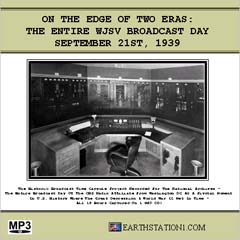
September 21, 1939: Broadcasting: The
History Of Broadcasting: Radio: The History Of Radio Broadcasting:
-- WJSV, a CBS radio affiliate in Washington, D.C., records its
entire 19-hour broadcast day as a time capsule project for The
National Archives, capturing a pivotal moment in U.S. and world
history where the Greet Depression and World War II met in time.
The recording includes many famous radio programs of the time
(including Amos 'n Andy and Major Bowes' Original Amateur Hour),
local programs featuring Arthur Godfrey and John Charles Daly
before their national successes, a Cleveland Indians-Washington
Senators baseball game, and a speech by President Franklin
Roosevelt. The recording was saved in the National Archives and
still exists today. WJSV originally came on the air in 1926 as
WTRC in Brooklyn, New York then was moved to Arlington, Virginia,
the following year and became WJSV in 1928. CBS bought the station
from the previous owner in 1931, officially moved the station to
Washington, D.C., although the transmitter site remained in
Virginia. CBS made WJSV its affiliate in the nation's capital.
WJSV changed its call letters to WTOP in 1943; the station is
still on the air to this day.
https://store.earthstation1.com/wjsv-radio-mp3-cd-entire-broadcast-day-sep-3211939.html
Mon, 21 Sep 2026 06:55:00 PDT

September 21, 1942: Aviation: The History
Of Aviation: The History Of Military Aviation: Maiden Flights:
Military Aviation Maiden Flights: -- The Boeing B-29 Superfortress
-- whose 3B USD cost of design and production (equivalent to 52B
USD in 2024) far exceeded the 1.9B USD cost of the Manhattan
Project that produced the atomic bomb it was designed to carry,
making it the most expensive military project of the war -- makes
its first flight. The Boeing B-29 Superfortress is a four-engine
propeller-driven heavy bomber designed by Boeing, which was flown
primarily by the United States during World War II and the Korean
War. It was one of the largest aircraft operational during World
War II and featured state of the art technology. Innovations
introduced included a pressurized cabin, dual-wheeled, tricycle
landing gear, and an analog computer-controlled fire-control
system that directed four remote machine gun turrets that could be
operated by a single gunner and a fire-control officer. A manned
tail gun installation was semi-remote. The name "Superfortress"
continued the pattern Boeing started with its well-known
predecessor, the B-17 Flying Fortress. Designed for the
high-altitude strategic bomber role, the B-29 also excelled in
low-altitude nighttime incendiary bombing missions. One of the
B-29's final roles during World War II was carrying out the atomic
bomb attacks on Hiroshima and Nagasaki.
https://store.earthstation1.com/war-props-the-boeing-b29-superfortress-dvd-mp4-294.html
Mon, 21 Sep 2026 06:55:00 PDT

September 21, 1953: Korea: The History Of
Korea: The Aftermath Of World War II: The Cold War: The Cold War
In Asia: The Korean Conflict: The Cold War (1947-1953): The Cold
War In Asia: The Korean War: Air Warfare Of The Korean War:
Operation Moolah: -- Lieutenant No Kum-sok, a North Korean pilot,
defects to South Korea in accordance with, but unaware of,
Operation Moolah, a United States Air Force effort during the
Korean War to obtain through defection a fully capable Soviet
MiG-15 jet fighter with the promise of a reward of 100K USD
"moolah" (contemporary slang for "money",
equivalent to 955,597 USD in 2019) for the first pilot to defect
with an operational aircraft. Kenneth H. Rowe (born No Kum-sok; b.
January 10, 1932) is a Korean American engineer and aviator who
served as a senior lieutenant in the Korean People's Army Air and
Anti-Air Force during the Korean War who two some months after the
end of hostilities defected to South Korea in a MiG-15 aircraft,
and was subsequently granted political asylum in the United
States. Communist forces introduced the MiG-15 to Korea on
November 1, 1950. USAF pilots reported that the performance of the
MiG-15 was superior to all United Nations (U.N.) aircraft,
including the USAF's newest plane, the F-86 Sabre. The operation
focused on influencing Communist pilots to defect to South Korea
with a MiG for a financial reward. The success of the operation
had been disputable since no Communist pilot defected before the
armistice was signed on July 27, 1953, and one North Korean pilot
No Kum-Sok flew his MiG-15 to the Kimpo Air Base, South Korea, he
was unaware of Operation Moolah. After being taken into custody
and debriefed by CIA operative "Andy Brown" (born Arseny
Yankovsky, son of Yuri Yankovsky), No received his 100K USD reward
offered by Operation Moolah, which he said he never heard of prior
to his defection. No explained that North Korean pilots were not
allowed to listen to South Korean radio, the leaflets broadcasting
the award were not dropped in Manchuria where the pilots were
based, and even if they had heard about the reward the amount of
money would have been meaningless to the young Communists; he said
the program would have been more effective if they had offered a
good job and residence in North America. President Dwight D.
Eisenhower was against paying defectors. After arriving in the
United States, Kum-sok anglicized his name to Kenneth H. Rowe, and
was joined in the U.S. by his mother, who had been evacuated from
North Korea earlier in 1951. He subsequently graduated from the
University of Delaware, with degrees in mechanical and electrical
engineering. He married an emigre from Kaesong, North Korea, they
raised two sons and a daughter, and he became a U.S. citizen. He
worked as an aeronautical engineer for Grumman, Boeing, Pan Am,
General Dynamics, General Motors, General Electric, Lockheed,
DuPont, and Westinghouse. In 1970, he learned from a fellow
defector that, as punishment for his defection, many of his former
pilot associates we executed by firing squad. One of the pilots
and a friend in his squadron became the General of the Korean
People's Army. General O Kuk-ryol, who became the vice chairman of
the National Defence Commission in 2009, was considered the second
most powerful man in North Korea. In 1996, he wrote and published
a book, A MiG-15 to Freedom, about his defection and previous life
in North Korea. Rowe retired in 2000 after working 17 years as an
aeronautical engineering professor at Embry-Riddle Aeronautical
University. A biography of No by Blaine Harden was published in
2015 as The Great Leader and the Fighter Pilot: The True Story of
the Tyrant Who Created North Korea and The Young Lieutenant Who
Stole His Way to Freedom. Harden had access to newly released
intelligence, and to No.
https://store.earthstation1.com/war-jets-duel-over-korea-f86-sabre-vs-mig15-fagot-mp4-downloa86154.html
Mon, 21 Sep 2026 06:55:00 PDT

September 21, 1966: The Aftermath Of
World War II: The Cold War: The Dominican Civil War (April 24,
1965 - September 3, 1965) (Spanish: Guerra Civil Dominicana), (The
April Revolution (Spanish: Revolucion De Abril): The United States
Occupation Of The Dominican Republic (April 28, 1965 - September
21, 1966): Operation Power Pack (United States Intervention In The
Dominican Civil War): -- Operation Power Pack, The United States
Occupation Of The Dominican Republic, comes to an end as the
closing chapter of The Dominican Civil War. On April 28, 1965:,
allegations of communist support for the constitutionalist rebels
against the militarily installed loyalist dictator president
Donald Reid Cabral results in a United States intervention in the
conflict, codenamed Operation Power Pack, to support the loyalist
cause. In the early morning of April 27, US diplomats in Santo
Domingo initiated preparations for evacuating 3,500 U.S. citizens
by sending a group of 1,176 foreign civilians who had assembled in
Hotel Embajador for airlifting to the Bajos de Haina naval
facility, where they boarded USS Ruchamkin and USS Wood County, as
well as the helicopters of HMM-264, which evacuated them from the
island to USS Boxer and USS Raleigh. Later that day, 1,500
Loyalist troops, supported by armored cars and tanks, marched from
the San Isidro Air Base, captured Duarte Bridge, and took position
on the west bank of the Ozama River. A second force, consisting of
700 soldiers, left San Cristobal and attacked the western suburbs
of Santo Domingo. Wessin y Wessin ordered his armored units to
cross the Duarte Bridge into Santo Domingo's center. However, the
tanks quickly became bogged down in fierce combat within the
narrow streets; armed civilians destroyed them. Unable to advance,
the Loyalists retreated to San Isidro. The battle resulted in
hundreds of casualties. Rebels overran the Fortaleza Ozama police
headquarters and took 700 prisoners. On April 28, armed civilians
attacked the Villa Consuelo police station and executed all of the
police officers who survived the initial skirmish. One US Marine
battalion landed in Haina and later moved to Hotel Embajador,
where it provided assistance in the upcoming airlifts. During the
night, 684 civilians were airlifted to USS Boxer. One US Marine
was killed by a rebel sniper during the operation. On April 29,
the US ambassador to the Dominican Republic, William Tapley
Bennett, who had sent numerous reports to US President Lyndon
Johnson, reported that the situation had reached life-threatening
proportions for US citizens and that the rebels were Communists.
Bennett stressed that the US had to act immediately, as the
creation of an international coalition would be time-consuming.
Contrary to the suggestions of his advisers, Johnson authorized
the transformation of evacuation operations into a large-scale
military intervention through Operation Power Pack, which was
aimed to prevent the development of what he saw as a second Cuban
Revolution. It was the first overt U.S. military intervention in
Latin America in more than 30 years, although it came on the heels
of U.S.-backed coups in Guatemala and Brazil, as well as ongoing
covert operations in Cuba. At 2:16 a.m. on April 30, 1965, the 3rd
Brigade of the 82nd Airborne Division landed at the San Isidro Air
Base and started the US military intervention in the conflict.
During the next couple of hours, two brigade combat teams and
heavy equipment were also dispatched. At sunrise the 1st
Battalion, 508th Infantry Regiment moved up the San Isidoro
highway under the cover of F-4 Phantom jets flying from Puerto
Rico, securing a position east of the Duarte bridge. More units of
the 82nd Airborne landed and secured the entire east bank of the
Ozama River. Rebel positions across the river were destroyed by
105 mm howitzers. U.S. soldiers crossed the bridge and occupied a
six-block area on the western side of the Duarte Bridge, but
suffered casualties from sniper fire. The 1st Battalion 505th
Infantry Regiment remained at the airbase and sent out patrols to
the perimeter. A force of 1,700 Marines of the 6th Marine
Expeditionary Unit occupied an area containing a number of foreign
embassies. The locale was proclaimed an International Security
Zone by the Organization of American States (OAS). Earlier in the
day, the OAS also issued a resolution calling the combatants to
end all hostilities. At 4:30 p.m., representatives of the
loyalists, the rebels, and the US military signed a ceasefire that
was to take effect at 11:45 p.m. That timing favored the
demoralized Loyalists, who had lost control of Ciudad Colonial.
The Dominican Civil War took place in Santo Domingo, Dominican
Republic. It started when civilian and military supporters of the
overthrown democratically elected president Juan Bosch ousted the
militarily installed president Donald Reid Cabral from office. The
second coup prompted General Elias Wessin y Wessin to organize
elements of the military loyal to the dictator Reid ("loyalists"),
initiating an armed campaign against the "constitutionalist"
rebels. It started when civilian and military supporters of former
President Juan Bosch overthrew acting President Donald Reid
Cabral. The coup prompted General Elias Wessin y Wessin to
organise elements of the military loyal to President Reid, known
as loyalists, initiating an armed campaign against the so-called
constitutionalist rebels. Allegations of foreign support for the
rebels led to a United States intervention in the conflict, which
later transformed into an Organization of American States
occupation of the country. The rebels were holed up inside Santo
Domingo and refused to surrender. They were continuously bombarded
by the Dominican Air Force who aimed their bombs at the television
stations and radio stations, particularly Radio Santo Domingo, and
the National Palace. Americans and Dominicans skirmished several
times but fought only one battle, which occurred on June 15-16,
1965, in the Dominican-held Ciudad Nueva area of the city, where
the 82nd Airborne Division lost 5 KIA, 31 WIA, and 3 DOW, while
inflicting casualties of 67 KIA and 165 WIA on the Dominican
forces. Once Loyalist victory was achieved, Operation Power Pack
transformed from a United States military occupation into an
Organization of American States occupation of the country by a few
thousand Latin American troops of The Inter-American Peace Force,
who remained as peacekeepers in the Dominican Republic until June
1966 when Joaquin Balaguer was elected president. Later in the
same year, all remaining foreign troops departed from the country.
The conflict ultimately resulted in around 6,000 Dominican
casualties and 350 U.S. casualties.
https://store.earthstation1.com/decades-the-1960s-dvd-set-peter-jennings-tv-series-3-19603.html
Mon, 21 Sep 2026 06:55:00 PDT

September 21, 1968: The History Of
Rocketry: The History Of Spaceflight: The Aftermath Of World War
II: The Cold War: The Cold War (1962-1979): The Space Age: The
Space Race: The Discovery And Exploration Of The Solar System:
Missions To The Moon: Space Probes: Lunar Space Probes: The Soviet
Space Program: The Zond Program: Zond 5 (Russian: Probe 5): -- The
first spacecraft to be launched to the moon to return, and the
first to bring terrestrial life forms to the vicinity of the
moon,, returns to Earth. Zond 5 was launched at 21:42:11 UTC atop
a Proton-K rocket from Baikonur Cosmodrome Site 81 in Kazakhstan.
In September 1968, Zond 5 became the second spaceship to travel to
and circle the Moon, and the first to return safely to Earth. Zond
5 carried the first terrestrial organisms to the vicinity of the
Moon, including two tortoises, fruit fly eggs, and plants. The
tortoises underwent biological changes during the flight, but it
was concluded that the changes were primarily due to starvation
and that they were little affected by space travel. The Zond
spacecraft was a version of the Soyuz 7K-L1 crewed lunar-flyby
spacecraft. It was launched by a Proton-K carrier rocket with a
Block D upper-stage to conduct scientific studies during its lunar
flyby.
https://store.earthstation1.com/to-the-moon-the-story-in-sound-complete-6-album-set-mp3-63.html
Mon, 21 Sep 2026 06:55:00 PDT
September 21, 1981: First Females: The
United States: The History Of The United States: The Supreme Court
Of The United States (SCOTUS): -- Sandra Day O'Connor is
unanimously approved by the U.S. Senate as the first female
Supreme Court justice. Sandra Day O'Connor (March 26, 1930 -
December 1, 2023) was born Sandra Day in El Paso, Texas, the
daughter of Harry Alfred Day, a rancher, and Ada Mae (Wilkey). She
was an Associate Justice of the Supreme Court Of The United
States, having served from her appointment in 1981 by Ronald
Reagan until 2006. She is the first woman to have served on the
Court. Prior to O'Connor's tenure on the Court, she was an elected
official and judge in Arizona serving as the first female Majority
Leader of a state senate as the Republican leader in the Arizona
Senate. Upon her nomination to the Court, O'Connor was confirmed
unanimously by the Senate. On July 1, 2005, she announced her
intention to retire effective upon the confirmation of a
successor. Samuel Alito was nominated to take her seat in October
2005, and joined the Court on January 31, 2006. Considered a
federalist and a moderate Republican, O'Connor tended to approach
each case narrowly without arguing for sweeping precedents. She
most frequently sided with the Court's conservative bloc, although
in the latter years of her tenure, she was regarded as having the
swing opinion in many cases. She often wrote concurring opinions
that limited the reach of the majority holding. Her majority
opinions in landmark cases include Grutter v. Bollinger and Hamdi
v. Rumsfeld. She also wrote in part the per curiam majority
opinion in Bush v. Gore, and was one of three co-authors of the
lead opinion in Planned Parenthood v. Casey. O'Connor was
Chancellor of The College of William and Mary in Williamsburg.
Several publications have named her among the most powerful women
in the world. On August 12, 2009, she was awarded the Presidential
Medal Of Freedom, the highest civilian honor of the United States,
by President Barack Obama. O'Connor died in Phoenix, at the age of
93, due to complications related to advanced dementia and a
respiratory illness. After her death, Chief Justice John Roberts
called her "an eloquent advocate for civil education"
and a "fiercely independent defender of the rule of law"
in a public statement. President Joe Biden said she was an
"American icon", dedicated to public service and the
"bedrock American principle of an independent judiciary."
iCivics board chairman Larry Kramer said that O'Connor was "kind
and generous" and relayed that iCivics was her "brainchild".
O'Connor lay in repose in the Great Hall of the Supreme Court on
December 18, 2023. She was memorialized the following day in a
funeral service held at the Washington National Cathedral. She is
buried at The Lazy B Ranch in Duncan, Arizona.
https://store.earthstation1.com/ronald-reagan-dvd-tv-biography.html
Mon, 21 Sep 2026 06:55:00 PDT

September 21, 1972: The Aftermath Of
World War II: The Cold War: The Cold War (1979-1985): The Cold War
Era Of Stagnation (1964-1982): The Cold War In Asia: The
Philippines: The History Of The Phillipines: The Presidency Of The
Philippines: The Presidency Of Ferdinand Marcos (1965-1986):
Martial Law In The Philippines: Martial law Under Ferdinand Marcos
(1972-1981): Proclamation No. 1081: -- Philippine President
Ferdinand Marcos signs Proclamation No. 1081, placing the entire
country under martial law and marking the beginning of his
authoritarian rule. It was announced to the public two days later,
on September 23 1972. The proclamation marked the beginning of a
14-year period of one man rule which would effectively last until
Marcos was exiled from the country on February 25, 1986. Even
though the formal document proclaiming Martial Law - Proclamation
No. 1081 - was formally lifted on January 17, 1981, Marcos
retained virtually all of his powers as dictator until he was
ousted by the People Power Revolution (also known as the EDSA
Revolution, the Philippine Revolution of 1986, or simply EDSA
1986). Numerous explanations have been put forward as reasons for
Marcos to declare Martial Law in September 1972, some of which
were presented by the Marcos administration as official
justifications, and some of which were dissenting perspectives put
forward by either the mainstream political opposition or by
analysts studying the political economy of the decision. In his
1987 treatise, "Dictatorship and Martial Law: Philippine
Authoritarianism in 1972," University of the Philippines
Public Administration Professor Alex Brillantes Jr. identifies
three reasons expressed by the Marcos administration, saying that
Martial Law: 1) was a response to various leftist and rightist
plots against the Marcos administration; 2) was just the
consequence of political decay after American-style democracy
failed to take root in Philippine society; and 3) was a reflection
of Filipino society's history of authoritarianism and supposed
need for iron-fisted leadership. The first two justifications were
explicitly stated in Proclamation 1081, which cited two explicit
justifications: "to save the republic" (from various
plots); and "to reform society" (after the failure of
American-style democracy). The third rationalization arose from
the administration's propaganda, which portrayed Ferdinand Marcos
as a hypermasculine figure able to compel the obedience of
supposedly "spoiled" filipinos. Opposition to Marcos'
declaration of Martial Law ran the whole gamut of Philippine
society - ranging from impoverished peasants whom the
administration tried to chase out of their homes; to the
Philippines' political old-guard, whom Marcos had tried to
displace from power; to academics and economists who disagreed
with the specifics of Marcos' Martial Law policies. All of these,
regardless of their social position or policy beliefs, subscribed
to the interpretation that Marcos declared martial law as a
strategy to enable him to stay in power past the two Presidential
terms allowed him under Philippine Constitution of 1935, and that
it was a technique for covering up the ill-gotten wealth of
Marcos, his family, and his cronies. In addition, some critics who
ascribe an economic component to Marcos' motivations, suggest that
martial law 1) was an acquiescence to the global market system,
which required tight control of sociopolitical systems so that the
country's resources could be exploited efficiently; 2) was a
product of the infighting among the families that formed the upper
socioeconomic class of Philippine society; and 3)was a connivance
between the state powers and the upperclass families to keep the
members of the country's lower classes from becoming too powerful.
Several conflicting accounts exist regarding the exact date on
which Marcos signed the physical Proclamation No. 1081 document.
Differing accounts suggest that Marcos signed the document as
early as September 17,1972, or as late as September 22, 1972.
Whichever the case, the document was formally dated 21 September
because of his superstitions and numerological beliefs concerning
the number seven. The Official Gazette of the republic of the
Philippines, in a restrospective article on Marcos' proclamation
of Martial Law, comments on the differences in the accounts:
"Whether they conflict or not, all accounts indicate that
Marcos' obsession with numerology (particularly the number seven)
necessitated that Proclamation No. 1081 be officially signed on a
date that was divisible by seven. Thus, September 21, 1972 became
the official date that Martial Law was established and the day
that the Marcos dictatorship began. This also allowed Marcos to
control history on his own terms." By the morning of
September 23, 1972, Martial Law forces had successfully
implemented a media lockdown, with only outlets associated with
Marcos crony Roberto Benedicto allowed to operate. In the
afternoon, Benedicto-owned television channel KBS-9 went back on
air playing episodes of Hanna-Barbera's Wacky Races cartoon
series, which was interrupted at 3:00 PM, when Press Secretary
Francisco Tatad went on air to read Proclamation No. 1081, through
which Marcos declared Martial Law. Ferdinand Marcos himself went
on air at 7:15 that evening to formalize the announcement. On the
following Morning, September 24, the headline of Benedicto's Daily
Express announced "FM Declares Martial Law" - the only
newspaper to come out in the immediate aftermath of Martial Law.
Martial law was ratified by 90.77% of the voters during the
controversial Philippine Martial Law referendum, 1973.
https://store.earthstation1.com/a-rustling-of-leaves-inside-the-philippine-revolution-dvd.html
Mon, 21 Sep 2026 06:55:00 PDT

( #JCKaelin here: I don't personally know
Mr. Kurtis, but we were both close friends and champions of Iva
Toguri, falsely known as "Tokyo Rose", and have each
worked on various projects involving her, and we each were made
aware of and briefed by her and others of each other's works on
her behalf. That, in addition to the great work he's done over the
years, makes me especially fond of him, and I pray for his health,
well being and success :) ) ========= September 21, 1940: #BOTD:
#HBD! Bill Kurtis, American radio and television journalist,
producer narrator, and news anchor, is #born William Horton
Kuretich in Pensacola, Florida, to Wilma Mary Horton (1911-2002)
and William A. Kuretich (Croatian: Kuretic), of Croatian origin
(1914-2001), a United States Marine Corps brigadier general and
decorated veteran of World War II. Kurtis was studying to become a
lawyer in the 1960s, when he was asked to fill in on a temporary
news assignment at WIBW-TV in Topeka, Kansas. His reporting on a
devastating tornado outbreak led to an on air news reporter and
later a very successful news anchor position in Chicago. He has
been noted for his sonorous voice throughout his career. In the
early 1980s, he anchored The CBS Morning News in New York City and
became especially interested in investigative in-depth reports and
documentaries. When he returned to Chicago and for a time resumed
his anchor duties, he also founded a production company, Kurtis
Productions. Kurtis hosted or produced a number of crime and news
documentary shows, including Investigative Reports, American
Justice, and Cold Case Files. Kurtis is currently the
scorekeeper/announcer for National Public Radio (NPR)'s news
comedy/quiz show Wait Wait... Don't Tell Me!, as well as serving
as the host of Through the Decades, a documentary-style news
magazine seen on Decades.
https://store.earthstation1.com/secret-intelligence-us-espionage-history-tv-series-dvd-mp4-us4.html
Mon, 21 Sep 2026 06:55:00 PDT

( #JCKaelin here: Shortly after Chuck
passed, I was recruited by the executors of Chuck Jones' estate in
an unrealized project to release the book "Letters From The
HeAesthetics: Art: Letters To Chuck Jones", selections from
Chuck's fan mail over the years :) ) ========= September 21, 1912:
#BOTD: #HBD! Chuck Jones, American animator, director, producer,
producer and screenwriter, best known for his work with Warner
Bros. Cartoons on the Looney Tunes and Merrie Melodies series of
shorts (d. February 22, 2002) is #born Charles Martin Jones in
Spokane, Washington. Chuck Jones wrote, produced, and/or directed
many classic Animated Cartoon shorts starring Bugs Bunny, Daffy
Duck, Wile E. Coyote and the Road Runner, Pepe Le Pew, and Porky
Pig, among others. Jones started his career in 1933 alongside Tex
Avery, Friz Freleng, Bob Clampett, and Robert McKimson at the Leon
Schlesinger Production's Termite Terrace studio, where they
created and developed the Looney Tunes characters. During the
Second World War, Jones directed many of the Private Snafu
(1943-1946) shorts which were shown to members of the United
States military. After his career at Warner Bros. ended in 1962,
Jones started Sib Tower 12 Productions and began producing
cartoons for Metro-Goldwyn-Mayer, including a new series of Tom
and Jerry shorts (1963-1967) as well as the television adaptations
of Dr. Seuss's How the Grinch Stole Christmas! (1966) and Horton
Hears a Who! (1970). He later started his own studio, Chuck Jones
Enterprises, where he directed and produced the film adaptation of
Norton Juster's The Phantom Tollbooth (1970). Jones's work along
with the other animators was showcased in the documentary, Bugs
Bunny: Superstar (1975). Jones directed the first feature-length
animated Looney Tunes compilation film, The Bugs Bunny/Road Runner
Movie (1979). In 1990 he wrote his memoir, Chuck Amuck: The Life
and Times of an Animated Cartoonist, which was made into a
documentary film, Chuck Amuck (1991). He was also profiled in the
American Masters documentary Chuck Jones: Extremes &
Inbetweens - A Life in Animation (2000) which aired on PBS. Jones
won three Academy Awards. The cartoons which he directed, For
Scent-imental Reasons, So Much for So Little, and The Dot and the
Line won the Best Animated Short. Robin Williams presented Jones
with an Honorary Academy Award in 1996 for his work in the
animation industry. Film historian Leonard Maltin has praised
Jones's work at Warner Bros., MGM and Chuck Jones Enterprises. In
Jerry Beck's The 50 Greatest Cartoons, a group of animated
professionals ranked What's Opera, Doc? (1957) as the greatest
cartoon of all time, with ten of the entries being directed by
Jones including Duck Amuck (1953), Duck Dodgers in the 24_th
Century (1953), One Froggy Evening (1955), Rabbit of Seville
(1950), and Rabbit Seasoning (1952). Chuck Jones died of
congestive heart failure at his home in Corona del Mar, Newport
Beach at the age of 89. He was cremated and his ashes were
scattered at sea.
https://store.earthstation1.com/world-war-ii-propaganda-cartoons-dvd-dual-layer-all-regions.html
Mon, 21 Sep 2026 06:55:00 PDT

September 21, 1792: The Age Of
Enlightenment (The Enlightenment, The Age Of Reason): The Age Of
Revolution: The Atlantic Revolutions: The French Revolution: The
Proclamation Of The Abolition Of The Monarchy: -- The National
Convention in Paris, the third government of the French
Revolution, declares France a republic (resulting in the founding
of the First French Republic the following day, September 22) and
issues its Proclamation of the Abolition of the Monarchy. The
Convention's deputies (deputes) were instructed to put an end to
the crisis that had broken out since the prevented flight to
Varennes of Louis XVI (June 1791) and the bloody capture of the
Tuileries (10 August 1792). Their middle-class origin and their
political activity meant that most of them bore no sympathy for
the monarchy, and the victory at the Battle Of Valmy on 20
September (the revolution's first military success) occurred on
the same day as their meeting, thus confirming their convictions.
When the depute for Paris, Jean-Marie Collot d'Herbois, proposed
abolition of the monarchy, he met with little resistance; at most,
Claude Basire, friend of Georges Jacques Danton, tried to temper
the enthusiasm, recommending a discussion before any decision.
However, abbe Henri Gregoire, constitutional bishop of Blois,
replied strongly to any suggestion of discussion: "What need
do we have of discussion when everyone is in agreement? Kings are
as much monsters in the moral order as in the physical order. The
Courts are a workshop for crime, the foyer for corruption and the
den of tyrants. The history of kings is the martyrology of
nations!" Girondist depute Jean-Francois Ducos supported him
in affirming that any discussion would be useless "after the
lights spread by 10 August". The summary argument served as a
debate and the decision taken was unanimous, giving birth to the
First French Republic. In the wake of the proclamation, efforts
grew to eliminate the vestiges of the ancien regime (the political
and social system of the Kingdom of France). As the date of the
Republic's first anniversary approached, the Convention passed a
set of laws replacing many familiar ancien systems of order and
measurement, including the old Christian calendar. This dramatic
change was powerful encouragement to the growing wave of
anticlericalism which sought a dechristianisation of France. The
new French Republican Calendar discarded all Christian reference
points and calculated time from the Republic's first full day
after the monarchy, September 22, 1792, the first day of Year One.
https://store.earthstation1.com/the-french-revolution-dvd-3-part-tv-documentary-serie3.html
Mon, 21 Sep 2026 06:55:00 PDT

September 21, 1866: #BOTD: #HBD! H. G.
Wells, English novelist, historian, and critic, prolific in many
genres, including the novel, history, politics, social commentary,
textbooks and rules for war games, best remembered for his science
fiction novels, called a "father of science fiction",
along with Jules Verne and Hugo Gernsback, whose most notable
science fiction works include The Time Machine (1895), The Island
of Doctor Moreau (1896), The Invisible Man (1897), The War Of The
Worlds (1898) and Things to Come (1936) (d. August 13, 1946) is
#born Herbert George Wells at Atlas House, 162 High Street in
Bromley, Kent, England. H. G. Wells was nominated for the Nobel
Prize in Literature four times. Prior to 1933, Wells' books were
widely read in Germany and Austria. By 1933, he had attracted the
attention of German officials because of his criticism of the
political situation in Germany, and on 10 May 1933, Wells' books
were burned by the Nazi youth in Berlin's Opernplatz, and his
works were banned from libraries and bookstores. Wells, as
president of PEN International (Poets, Essayists, Novelists),
angered the Nazis by overseeing the expulsion of the German PEN
club from the international body in 1934 following the German
PEN's refusal to admit non-Aryan writers to its membership. At a
PEN conference in Ragusa, Wells refused to yield to Nazi
sympathisers who demanded that the exiled author Ernst Toller be
prevented from speaking. Near the end of the World War II, Allied
forces discovered "The Black Book", a secret list of
prominent British residents to be arrested, produced in 1940 by
the SS as part of the preparation for the proposed invasion of
Britain codenamed Operation Sea Lion, with Wells included in the
alphabetical list. H. G. Wells died aged 79 at his home at 13
Hanover Terrace, overlooking Regent's Park, London, England In his
preface to the 1941 edition of The War in the Air, Wells had
stated that his epitaph should be: "I told you so. You damned
fools". Wells's body was cremated at Golders Green
Crematorium on August 16, 1946; his ashes were subsequently
scattered into the English Channel at Old Harry Rocks, the most
eastern point of the Jurassic Coast and about 3.5 miles (5.6 km)
from Swanage in Dorset. A commemorative blue plaque in his honour
was installed by the Greater London Council at his home in
Regent's Park in 1966.
https://store.earthstation1.com/warofwobyhgw.html
Mon, 21 Sep 2026 06:55:00 PDT

September 21, 1780: The Age Of
Enlightenment (The Enlightenment, The Age Of Reason): The Age Of
Revolution: The Atlantic Revolutions: The American Enlightenment:
The American Revolution: The American Revolutionary War: The
Betrayal Of Benedict Arnold: -- Benedict Arnold gives the British
the plans to West Point. Benedict Arnold (January 14, 1741 [O.S.
January 3, 1740]: June 14, 1801) was a general during the American
Revolutionary War, who fought for the American Continental Army,
and later defected to the British Army. While a general on the
American side, he obtained command of the fortifications at West
Point, New York (which after 1802 would become the site of the
U.S. Military Academy), overlooking the cliffs at the Hudson River
(upriver from British-occupied New York City), and planned to
surrender them to British forces. This plan was exposed in
September 1780. He was commissioned into the British Army as a
brigadier general.
https://store.earthstation1.com/american-revolutionary-war-dvd-documentaries.html
Mon, 21 Sep 2026 06:55:00 PDT
September 21, 1877: #BOTD: Fritz Joubert
Duquesne (or Du Quesne), South African Boer and German soldier,
big-game hunter, journalist, spy and con man (d. May 24, 1956) is
#born in East London, Cape Colony (also known as The Cape Of Good
Hope) in present-day South Africa. He fought on the side of the
Boers in the Second Boer War and as a secret agent for Germany
during both World Wars. He gathered human intelligence, led spy
rings and carried out sabotage missions as a covert field asset in
South Africa, Great Britain, Central and South America, and the
United States. He went by many aliases, fictionalized his identity
and background on multiple occasions, and operated as a con man.
As a Boer spy he was known as the "Black Panther", in
World War II he operated under the code name DUNN, and in FBI
files he is frequently referred to as "The Duke". He was
captured, convicted, and escaped several prisons. During the
Second Boer War, from 1899 to 1902, Duquesne was captured and
imprisoned three times by the British and once by the Portuguese,
and each time he escaped. On one occasion he infiltrated the
British army, became a British officer, and led an attempt to
sabotage Cape Town and to assassinate the commander-in-chief Lord
Kitchener. His team was given up by an informant and all were
captured and sentenced to death. After a failed attempt to escape
prison in Cape Town, he was sent to prison in Bermuda, but he
escaped to the United States and became an American citizen. In
World War I, he became a spy and ring leader for Germany and
during this time he sabotaged British merchant ships in South
America with concealed bombs and destroyed several. He sometimes
purchased insurance on merchandise he shipped on the vessels he
sabotaged and then filed claims for damages. He became known as
"the man who killed Kitchener" since he claimed to have
guided a German U-boat to sink HMS Hampshire on which Lord
Kitchener was en route to Russia in 1916, although forensics of
the ship do not support this claim. After he was caught by federal
agents in New York in 1917, he feigned paralysis for two years and
cut the bars of his cell to make his escape, thereby avoiding
deportation to England where he faced execution for the deaths of
British sailors. In 1932, he was again captured in New York by
federal agents and charged with both homicide and for being an
escaped prisoner, only this time he was set free after Britain
declined to pursue the wartime crimes. The last time he was
captured and imprisoned was in 1941 when he and 32 other members
of the Duquesne Spy Ring were caught by William G. Sebold, a
double agent with the FBI. On January 2, 1942, The Federal Bureau
of Investigation (FBI) sentenced 33 members of a German spy ring
headed by Duquesne to serve a total of over 300 years in prison in
the largest espionage case in United States history. The Duquesne
Spy Ring is the largest espionage case in the United States
history that ended in convictions. A total of 33 members of a
German espionage network headed by Frederick "Fritz"
Joubert Duquesne were convicted after a lengthy investigation by
the FBI. Of those indicted, 19 pleaded guilty. The remaining 14
were brought to jury trial in Federal District Court, Brooklyn,
New York, on September 3, 1941; all were found guilty on December
13, 1941. The agents who formed the Duquesne Ring were placed in
key jobs in the United States to get information that could be
used in the event of war and to carry out acts of sabotage: one
opened a restaurant and used his position to get information from
his customers; another worked on an airline so that he could
report Allied ships that were crossing the Atlantic Ocean; others
worked as delivery people as a cover for carrying secret messages.
William G. Sebold, who had been blackmailed into becoming a spy
for Germany, became a double agent and helped the FBI gather
evidence. For nearly two years, the FBI ran a shortwave radio
station in New York for the ring. They learned what information
Germany was sending its spies in the United States and controlled
what was sent to Germany. Sebold's success as a counterespionage
agent was demonstrated by the successful prosecution of the German
agents. One German spymaster later commented the ring's roundup
delivered "the death blow" to their espionage efforts in
the United States. FBI director J. Edgar Hoover called his
concerted FBI swoop on Duquesne's ring the greatest spy roundup in
U.S. history. The 1945 film The House on 92nd Street was a thinly
disguised version of the Duquesne Spy Ring saga of 1941. Between
wars, Duquesne served as an adviser on big game hunting to U.S.
President Theodore Roosevelt, as a publicist in the movie
business, as a journalist, as a fictional Australian war hero, and
as head of the New Food Society in New York. During the Boer war
he had been under orders to kill Frederick Russell Burnham, Chief
of Scouts in the British Army, but in 1910 he worked with both
Burnham and then Rep. Robert Broussard to lobby the U.S. Congress
to fund the importation of hippopotamuses into the Louisiana
bayous to solve a severe meat shortage. Duquesne often took on
many identities, reinvented his past at will, attached his
ancestry to aristocratic clans, granted himself military titles
and medals, and spoke of many people, some fact and some
fictional. Fritz Joubert Duquesne died on May 24, 1956 at City
Hospital on Welfare Island (now Roosevelt Island), in New York
City at the age of 78. He is buried at the Potter's Field on Hart
Island, Bronx County, New York City.
https://store.earthstation1.com/gmen-the-rise-of-j-edgar-hoover-dvd.html
Mon, 21 Sep 2026 06:55:00 PDT

September 21, 1964: Aviation: The History
Of Aviation: The History Of Military Aviation: Maiden Flights: --
The North American XB-70 Valkyrie, the world's first Mach 3
bomber, makes its first flight, taking off from Palmdale,
California. The North American Aviation XB-70 Valkyrie was the
prototype version of the planned B-70 nuclear-armed,
deep-penetration strategic bomber for the United States Air Force
Strategic Air Command. Designed in the late 1950s by North
American Aviation, the six-engined Valkyrie was capable of
cruising for thousands of miles at Mach 3+ while flying at 70,000
feet (21,000 m). At these speeds, it was expected that the B-70
would be almost immune to interceptor aircraft, the only effective
weapon against bomber aircraft at the time. The bomber would spend
only a few minutes over a particular radar station, flying out of
its range before the controllers could position their fighters in
a suitable location for an interception. High speed also made the
aircraft difficult to see on radar displays and its high-altitude
flight could not be matched by any contemporary Soviet fighter.
The introduction of the first Soviet surface-to-air missiles in
the late 1950s put the near-invulnerability of the B-70 in doubt.
In response, the United States Air Force (USAF) began flying its
missions at low level, where the missile radar's line of sight was
limited by local terrain. In this low-level penetration role, the
B-70 offered little additional performance over the B-52 it was
meant to replace, while being far more expensive with shorter
range. Other alternate missions were proposed, but these were of
limited scope. With the advent of intercontinental ballistic
missiles (ICBMs) during the late 1950s, manned bombers were
increasingly seen as obsolete. The USAF eventually gave up
fighting for its production and the B-70 program was canceled in
1961. Development was then turned over to a research program to
study the effects of long-duration high-speed flight. As such, two
prototype aircraft, designated XB-70A, were built; these aircraft
were used for supersonic test-flights during 1964-69. In 1966, one
prototype crashed after colliding with a smaller aircraft while
flying in close formation; the remaining Valkyrie bomber is in the
National Museum of the United States Air Force near Dayton, Ohio.
https://store.earthstation1.com/war-jets-the-north-american-xb70-valkyrie-d70.html
Mon, 21 Sep 2026 06:55:00 PDT

September 21, 1937: First Publications:
-- J. R. R. Tolkien's The Hobbit is published. The Hobbit, or
There And Back Again, is a children's fantasy novel by English
author J. R. R. Tolkien. It was published to wide critical
acclaim, being nominated for the Carnegie Medal and awarded a
prize from the New York Herald Tribune for best juvenile fiction.
It is recognized as a classic in children's literature and is one
of the best-selling books of all time, with over 100 million
copies sold. The Hobbit is set in Middle-earth and follows
home-loving Bilbo Baggins, the titular hobbit who joins the wizard
Gandalf and the thirteen dwarves of Thorin's Company on a quest to
reclaim the dwarves' home and treasure from the dragon Smaug.
Bilbo's journey takes him from his peaceful rural surroundings
into more sinister territory. The story is told in the form of a
picaresque or episodic quest;[1] several chapters introduce a new
type of monster or threat as Bilbo progresses through the
landscape. Bilbo gains a new level of maturity, competence, and
wisdom by accepting the disreputable, romantic, fey and
adventurous sides of his nature and applying his wits and common
sense. The story reaches its climax in the Battle of Five Armies,
where many of the characters and creatures from earlier chapters
re-emerge to engage in conflict. Personal growth and forms of
heroism are central themes of the story, along with motifs of
warfare. These themes have led critics to view Tolkien's own
experiences during the First World War as instrumental in shaping
the story. His scholarly knowledge of Germanic philology and
interest in mythology and fairy tales are often noted as
influences, but more recent fiction including adventure stories
and the works of William Morris also played a part. The publisher
was encouraged by the book's critical and financial success and,
therefore, requested a sequel. As Tolkien's work progressed on its
successor, The Lord of the Rings, he made retrospective
accommodations for it in The Hobbit. These few but significant
changes were integrated into the second edition. Further editions
followed with minor emendations, including those reflecting
Tolkien's changing concept of the world into which Bilbo stumbled.
The work has never been out of print. Its ongoing legacy
encompasses many adaptations for stage, screen, radio, board games
and video games. Several of these adaptations have received
critical recognition on their own merits.
https://store.earthstation1.com/j-r-r-tolkien-documentaries-dvd-mp4-download-usb-driv4.html
Mon, 21 Sep 2026 06:55:00 PDT
September 21, 1914: #BOTD: #HBD! Slam
Stewart, African American jazz double bass player, whose trademark
style was his ability to bow the bass (arco) and simultaneously
hum or sing an octave higher (d. December 10, 1987) is #born Leroy
Eliot Stewart in Englewood, New Jersey. He was a violinist before
switching to bass at the age of 20. Stewart began playing string
bass while attending Dwight Morrow High School. While attending
the Boston Conservatory, he heard Ray Perry singing along with his
violin. This gave him the inspiration to follow suit with his
bass. In 1937, Stewart teamed with Slim Gaillard to form the
novelty jazz act Slim and Slam. The duo's biggest hit was "Flat
Foot Floogie (with a Floy Floy)" in 1938. Stewart found
regular session work throughout the 1940s with Lester Young, Fats
Waller, Coleman Hawkins, Erroll Garner, Art Tatum, Johnny
Guarnieri, Red Norvo, Don Byas, Benny Goodman, and Beryl Booker.
One of the most famous sessions he played on took place in 1945,
when Stewart played with Dizzy Gillespie's group (which featured
Charlie Parker). Out of those sessions came some of the classics
of bebop such as "Groovin' High" and "Dizzy
Atmosphere". He taught at Binghamton University in
Binghamton, New York, and at Yale University. He died of
congestive heart failure on December 10, 1987, in Binghamton, aged
73. His burial details are not publicly disclosed.
https://store.earthstation1.com/hellzapoppin39-dvd-olsen-and-johnson-vaudeville-lindyhoppi39.html
Mon, 21 Sep 2026 06:55:00 PDT

September 21, 1950: #BOTD: #HBD! Bill
Murray, American actor, comedian, writer, filmmaker, producer,
screenwriter and jerk is #born William James Murray in Evanston,
Illinois, to Lucille (nee Collins), a mail-room clerk, and Edward
Joseph Murray II, a lumber salesman. Known for his deadpan
delivery, he first rose to fame on Saturday Night Live, a series
of performances that earned him his first Emmy Award, and later
starred in comedy films including Meatballs (1979), Caddyshack
(1980), Stripes (1981), Tootsie (1982), Ghostbusters (1984),
Scrooged (1988), Ghostbusters II (1989), What About Bob? (1991)
and Groundhog Day (1993). He also co-directed Quick Change (1990).
Murray later starred in Sofia Coppola's Lost in Translation
(2003), which earned him a Golden Globe and a British Academy Film
Award, as well as an Oscar nomination for Best Actor. He also
frequently collaborated with directors Wes Anderson and Jim
Jarmusch. He received Golden Globe nominations for his roles in
Ghostbusters, Rushmore (1998), Hyde Park on Hudson (2012), St.
Vincent (2014), and the HBO miniseries Olive Kitteridge (2014),
for which he later won his second Primetime Emmy Award. Murray
received the Mark Twain Prize for American Humor in 2016.
https://store.earthstation1.com/television-1988-tv-documentary-series-8-shows-4-dual-laye198884.html
Mon, 21 Sep 2026 06:55:00 PDT

September 21, 1935: #BOTD: #HBD! Henry
Gibson, American actor, comedian, singer, dancer and soldier, best
known as a cast member of the TV sketch-comedy series Rowan &
Martin's Laugh-In from 1968 to 1971 (d. September 14, 2009) is
#born James Bateman in Germantown, Philadelphia. Henry Gibson was
also known for voicing the protagonist Wilbur in the 1973 animated
film Charlotte's Web, his portrayal of country star Haven Hamilton
in Robert Altman's 1975 film Nashville, as the Illinois Nazi
leader in the 1980 film The Blues Brothers, and for his
performance opposite Tom Hanks and Brother Theodore in 1989's The
'Burbs. After graduating from the Catholic University of America
in Washington, D.C., he served as an intelligence officer in the
United States Air Force with the 66th Tactical Reconnaissance Wing
in France from 1957 to 1960. Early in his career as a professional
entertainer, he developed a comedy act in which he played a poet
from Fairhope, Alabama. He adopted the stage name Henry Gibson,
which is a homophone for the name of famed Norwegian dramatist
Henrik Ibsen. He also is known to have used the name Olsen Gibson,
in honor of Ole Olsen of the Vaudevillian team Olsen and Johnson.
Henry Gibson died of cancer at his home in Malibu, California, a
week before his 74th birthday. He was cremated at Westwood Village
Memorial Park Cemetery and his ashes were given to his family.
https://store.earthstation1.com/rowan-and-martin-discount-set-2-albums-2-blooper-reel-sets-mp3-mp4-dvd.html
Mon, 21 Sep 2026 06:55:00 PDT
September 21, 1931: #BOTD: #HBD! Larry
Hagman, American actor, director, and producer, best known for
playing ruthless oil baron J. R. Ewing in the 1978-1991 primetime
television soap opera Dallas, and the handsome astronaut Major
Anthony Nelson in the 1965-1970 sitcom I Dream of Jeannie (d.
November 23, 2012) is #born Larry Martin Hagman Larry Hagman in
Fort Worth, Texas. His mother was Mary Martin, Broadway actress
and musical comedy star who became famous after his birth. His
father, Benjamin Jackson Hagman, who was of Swedish descent, was
an accountant and lawyer who worked as a district attorney.
Hagman's parents divorced in 1936 when he was five years old.
Hagman had supporting roles in numerous films, including
Fail-Safe, Harry And Tonto, S.O.B., Nixon, and Primary Colors. His
television appearances also included guest roles on dozens of
shows spanning from the late 1950s until his death, and a reprise
of his signature role on the 2012 revival of Dallas. Hagman also
worked as a television producer and director. Hagman underwent a
life-saving liver transplant in 1995. Larry Hagman died at Medical
City Dallas Hospital in Dallas, Texas from complications of acute
myeloid leukemia, aged 81. His remains were cremated, and the
ashes scattered over Southfork Ranch in Parker, Texas; Southfork
Ranch includes the Ewing Mansion, the setting for the television
series Dallas.
https://store.earthstation1.com/clive-james39-fame-in-the-20th-century-tv-series-dvd-set-mp4-usb-39204.html
Mon, 21 Sep 2026 06:55:00 PDT
 September 21, 19 BC: #DOTD: #RIP: Virgil
(Vergil), ancient Roman poet of the Augustan period, one of Rome's
greatest poets, composer of three of the most famous poems in
Latin literature: 1) The Eclogues (Latin: "Selections")
(or Bucolics, poetry offering a dramatic and mythic interpretation
of revolutionary change in Rome between roughly 44 and 38 BC.), 2)
The Georgics (Latin: Georgica, from the Greek Georgika,
"Agricultural [Things]), and 3) the epic poem The Aeneid
(Latin: "The Story Of Aeneas"), considered the national
epic of ancient Rome since the time of its composition (b. October
15, 70 BC) #dies; according to tradition, Virgil traveled to the
senatorial province of Achaea in Greece about 19 BC to revise the
Aeneid, and after meeting the Roman Emperor Augustus in Athens,
decided to return home, but caught a fever while visiting a town
near Megara, Greece. After crossing to Italy by ship, weakened
with disease, Virgil died in Brundisium Harbor (modern Brindisi,
Apulia, Italy, aged 50. Virgil's Tomb (Italian: Tomba di
Virgilio), a Roman burial vault in Naples, is said to be the tomb,
located at the entrance to the old Roman tunnel known as the
Crypta Neapolitana or Grotta Vecchia in the Piedigrotta district
of the city, between Mergellina and Fuorigrotta. Augustus ordered
Virgil's literary executors, Lucius Varius Rufus and Plotius
Tucca, to disregard Virgil's own wish that the poem be burned,
instead ordering it to be published with as few editorial changes
as possible. As a result, the text of the Aeneid that exists may
contain faults which Virgil was planning to correct before
publication. However, the only obvious imperfections are a few
lines of verse that are metrically unfinished (i.e. not a complete
line of dactylic hexameter). Some scholars have argued that Virgil
deliberately left these metrically incomplete lines for dramatic
effect. Other alleged imperfections are subject to scholarly
debate. Virgil was born Publius Vergilius Maroin the village of
Andes, near Mantua in Cisalpine Gaul (northern Italy, added to
Italy proper during his lifetime). The Aeneid, modeled after
Homer's Iliad and Odyssey, follows the Trojan refugee Aeneas as he
struggles to fulfill his destiny and reach Italy, where his
descendants Romulus and Remus were to found the city of Rome.
Virgil's work has had wide and deep influence on Western
literature, most notably Dante's Divine Comedy, in which Virgil
appears as Dante's guide through Hell and Purgatory. A number of
minor poems, collected in the Appendix Vergiliana, were attributed
to him in ancient times, but modern scholars consider his
authorship of these poems to be dubious. #Virgil #Vergil
#PubliusVergiliusMaro #Poets #Poetry #LatinPoetry #ClassicalPoetry
#RomanPoetry #Aeneid #NationalEpics #AppendixVergiliana #Rome
#AncientRome #RomanHistory #AncientRomanHistory #HistoryOfRome
#HistoryOfAncientRome #RomanEmpire #AugustanLiterature
#LatinLiterature #RomanLiterature #Latin #ClassicalLatin
#GoldenAgeOfLatinLiterature #WesternLiterature #EuropeanLiterature
#WesternCulture #WesternCivilization #OccidentalCulture
#WesternWorld #WesternSociety #WesternTradition
#StoryOfCivilization #MP3 #AudioDownload #DVD
https://store.earthstation1.com/story-of-civilization-will-amp-ariel-durant-mp3-dvd-11-audiobo311.html
September 21, 19 BC: #DOTD: #RIP: Virgil
(Vergil), ancient Roman poet of the Augustan period, one of Rome's
greatest poets, composer of three of the most famous poems in
Latin literature: 1) The Eclogues (Latin: "Selections")
(or Bucolics, poetry offering a dramatic and mythic interpretation
of revolutionary change in Rome between roughly 44 and 38 BC.), 2)
The Georgics (Latin: Georgica, from the Greek Georgika,
"Agricultural [Things]), and 3) the epic poem The Aeneid
(Latin: "The Story Of Aeneas"), considered the national
epic of ancient Rome since the time of its composition (b. October
15, 70 BC) #dies; according to tradition, Virgil traveled to the
senatorial province of Achaea in Greece about 19 BC to revise the
Aeneid, and after meeting the Roman Emperor Augustus in Athens,
decided to return home, but caught a fever while visiting a town
near Megara, Greece. After crossing to Italy by ship, weakened
with disease, Virgil died in Brundisium Harbor (modern Brindisi,
Apulia, Italy, aged 50. Virgil's Tomb (Italian: Tomba di
Virgilio), a Roman burial vault in Naples, is said to be the tomb,
located at the entrance to the old Roman tunnel known as the
Crypta Neapolitana or Grotta Vecchia in the Piedigrotta district
of the city, between Mergellina and Fuorigrotta. Augustus ordered
Virgil's literary executors, Lucius Varius Rufus and Plotius
Tucca, to disregard Virgil's own wish that the poem be burned,
instead ordering it to be published with as few editorial changes
as possible. As a result, the text of the Aeneid that exists may
contain faults which Virgil was planning to correct before
publication. However, the only obvious imperfections are a few
lines of verse that are metrically unfinished (i.e. not a complete
line of dactylic hexameter). Some scholars have argued that Virgil
deliberately left these metrically incomplete lines for dramatic
effect. Other alleged imperfections are subject to scholarly
debate. Virgil was born Publius Vergilius Maroin the village of
Andes, near Mantua in Cisalpine Gaul (northern Italy, added to
Italy proper during his lifetime). The Aeneid, modeled after
Homer's Iliad and Odyssey, follows the Trojan refugee Aeneas as he
struggles to fulfill his destiny and reach Italy, where his
descendants Romulus and Remus were to found the city of Rome.
Virgil's work has had wide and deep influence on Western
literature, most notably Dante's Divine Comedy, in which Virgil
appears as Dante's guide through Hell and Purgatory. A number of
minor poems, collected in the Appendix Vergiliana, were attributed
to him in ancient times, but modern scholars consider his
authorship of these poems to be dubious. #Virgil #Vergil
#PubliusVergiliusMaro #Poets #Poetry #LatinPoetry #ClassicalPoetry
#RomanPoetry #Aeneid #NationalEpics #AppendixVergiliana #Rome
#AncientRome #RomanHistory #AncientRomanHistory #HistoryOfRome
#HistoryOfAncientRome #RomanEmpire #AugustanLiterature
#LatinLiterature #RomanLiterature #Latin #ClassicalLatin
#GoldenAgeOfLatinLiterature #WesternLiterature #EuropeanLiterature
#WesternCulture #WesternCivilization #OccidentalCulture
#WesternWorld #WesternSociety #WesternTradition
#StoryOfCivilization #MP3 #AudioDownload #DVD
https://store.earthstation1.com/story-of-civilization-will-amp-ariel-durant-mp3-dvd-11-audiobo311.html
Mon, 21 Sep 2026 06:55:00 PDT
September 21, 1860: The Century Of
Humiliation (The Hundred Years Of National Humiliation)
(1838-1945): The Opium Wars: The Second Opium War (The Second
Anglo-Sino War, The Second China War, The Arrow War, The
Anglo-French Expedition To China): The Battle Of Palikao (French:
La Bataille De Palikao, Chinese: Baliqiao Zhi Zhan; "The
Battle Of The Eight-Mile Bridge"): -- An Anglo-French force
defeats Chinese troops on the morning of The Battle Of Palikao at
the bridge of Palikao. It allowed Western forces to take the
capital Beijing and eventually defeat the Qing Empire. The Second
Opium War was fought between the the allied British Empire and the
French Empire against the Qing dynasty of China, lasting from 1856
to 1860. The title "Second Opium War" refers to one of
the British strategic objectives: legalizing the opium trade,
expanding coolie trade, opening all of China to British merchants,
and exempting foreign imports from internal transit duties.
#BattleOfPalikao #SecondOpiumWar #OpiumWars #China #ChineseHistory
#HistoryOfChina #BritishEmpire #FrenchEmpire
#SecondAngloChineseWar #AngloFrenchExpeditionToChina #MP4
#VideoDownload #DVD
https://store.earthstation1.com/the-genius-that-was-china-dvd-tv-documentary-series-2-disc-se2.html
Mon, 21 Sep 2026 06:55:00 PDT
September 21, 1954: #DOTD: #RIP: Kokichi
Mikimoto, Japanese businessman and entrepreneur who is credited
with creating the first cultured pearl and subsequently starting
the cultured pearl industry with the establishment of his luxury
pearl company Mikimoto (b. January 25, 1858) #dies at the age of
96 near Nagoya, Japan. He is buried at Aoyama Cemetery, Minato-Ku,
Tokyo, Japan. Mikimoto's personal memorabilia are displayed at
Mikimoto Pearl Island Memorial Hall, a museum in located in his
home town of Toba, Shima Province (now Mie Prefecture) in the
Kansai region of Honshu, Japan, where he was born Mikimoto
Kokichi. Mikimoto's father was an udon shop owner. Seeing the
pearl divers of Ise unloading their treasures at the shore in his
childhood started his fascination with pearls. At the age of 20,
Mikimoto noticed the many flaws of pearls as he judged a pearl
exhibition in 1878. This began Mikimoto's search for the
development of the perfect pearl. On July 11, 1893, he created the
first cultured pearl, and he subsequently started the cultured
pearl industry with the establishment of his luxury pearl company
Mikimoto. In recognition of this achievement, he was inducted by
the imperial decree of Emperor Hirohito into the House Of Peers,
the upper house of the Imperial Diet from February 11, 1889 to May
3, 1947); he was also posthumously awarded the Grand Cordon of the
Order of the Sacred Treasure, and on April 18, 1985, the Japan
Patent Office selected him as one of Ten Japanese Great Inventors.
Cultured pearls are formed within a cultured pearl sac with human
intervention in the interior of productive living molluscs in a
variety of conditions depending upon the mollusc and the goals.
Having the same material as natural pearls, cultured pearls can be
cultivated in seawater or freshwater bodies. Today over 95% of the
pearls available on the market are cultured pearls. Mikimoto began
his search of an alternative method to produce pearls as the
chairman of the Shima Marine Products Improvement Association. At
this point the demand for pearls had severely outweighed the
supply, prompting the consideration of an effort to protect the
oysters. In 1888, Mikimoto obtained a loan to start his first
pearl oyster farm at the Shinmei inlet on Ago Bay in Mie
prefecture with his wife and partner Ume. On 11 July 1893, after
many failures and near bankruptcy, he was able to create the
hemispherical cultured pearls. The pearls were made by seeding the
oyster with a small amount of mother of pearl. Despite this major
discovery there were initially difficulties in selling his
cultured pearls due to public confusion. To encourage sales,
Mikimoto opened a jewelry boutique in Ginza where he was able to
have workers educate the consumer on the nature of the cultured
pearls. He introduced these pearls at a marine products exposition
in Norway in 1897 and began an export business. However, it took
him another 12 years to create completely spherical pearls that
were indistinguishable from the highest quality natural ones, and
commercially viable harvests were not obtained until the 1920s. In
1927, Mikimoto met with inventor, Thomas Edison, who was in awe of
Mikimoto's cultured pearls as it was "supposed to be
biologically impossible". Mikimoto did not know that
government biologist Tokichi Nishikawa and a carpenter, Tatsuhei
Mise, had each spent time in Australia and learned the secret to
spherical pearl production from expatriate British marine
biologist William Saville-Kent - inserting a piece of oyster
epithelial membrane (the lip of mantle tissue) with a nucleus of
shell or metal into an oyster's body or mantle causes the tissue
to form a pearl sack. The sack produces nacre, which coats the
nucleus, thus creating a pearl. Mise received a 1907 patent for
this grafting needle. When Nishikawa applied in the same year, he
realized that Mise had already secured a patent. In a compromise,
the pair agreed to cooperate, calling their discovery the
"Mise-Nishikawa method". Mikimoto had received a patent
in 1896 for producing hemispherical pearls, or mabes, and a 1908
patent for culturing in mantle tissue, but he could not use the
Mise-Nishikawa method without invalidating his own patents.
Mikimoto then altered his patent application to cover a technique
to make round pearls in mantle tissue, which was granted in 1916.
However, this method was not commercially viable. Mikimoto finally
made arrangements to use Nishikawa's methods after 1916, and
Mikimoto's business began to expand rapidly. After World War II,
Mikimoto opened stores in Paris, New York City, Chicago, Boston,
Los Angeles, San Francisco, Shanghai, and Bombay, and was thus one
of the first Japanese brands to attain an international presence
and recognition. The company is now ranked as one of the world's
most luxurious brands by Women's Wear Daily Magazine, and Mikimoto
was considered one of the best Japanese financial leaders of the
20th century by the Nihon Keizai Shimbun (Japanese: "Japan
Economics Newspaper", the world's largest financial
newspaper, with a daily circulation exceeding 1.73 million copies
as of 2023). He is also known as the founder of Mikimoto
Pharmaceuticals, a company specialising in beauty products
containing pearl calcium. Mikimoto Pearl Island is named after
him. In addition, the "Phoenix Mikimoto Crown" used by
Miss Universe winners as well as the pageant crown used by Miss
International is credited to his patented work. A pearl is a hard,
glistening object produced within the soft tissue (specifically
the mantle) of a living shelled mollusk or another animal, such as
fossil conulariids. Just like the shell of a mollusk, a pearl is
composed of calcium carbonate (mainly aragonite or a mixture of
aragonite and calcite) in minute crystalline form, which has
deposited in concentric layers. The ideal pearl is perfectly round
and smooth, but many other shapes, known as baroque pearls, can
occur. The finest quality of natural pearls have been highly
valued as gemstones and objects of beauty for many centuries.
Because of this, pearl has become a metaphor for something rare,
fine, admirable and valuable.
https://store.earthstation1.com/old-time-radio-crime-and-detective-megaset-3-dual-layer-mp3-dv33.html
Mon, 21 Sep 2026 06:55:00 PDT
September 21, 1966: #DOTD: #RIP: Paul
Reynaud, French lawyer and politician, 118th Prime Minister of
France (b. October 15, 1878) #dies at the age of 87 at
Neuilly-sur-Seine, France. He is buried at the Cimetiere Du
Montparnasse in Paris, France. Paul Reynaud was born in
Barcelonnette, Alpes-de-Haute-Provence in the southern French
Alps. He was prominent in the interwar period, noted for his
stances on economic liberalism and militant opposition to Germany.
After the outbreak of World War II Reynaud became the penultimate
Prime Minister of the Third Republic in March 1940. He was also
vice-president of the Democratic Republican Alliance center-right
party. Reynaud was Prime Minister during the German defeat of
France in May and June 1940; he persistently refused to support an
armistice with Germany and resigned on June 16. After
unsuccessfully attempting to flee France, he was arrested by
Philippe Petain's administration. Surrendered to German custody in
1942, he was imprisoned in Germany and later Austria until
liberation in 1945. Elected to the Chamber of Deputies in 1946, he
became a prominent figure again in French political life, serving
in several cabinet positions. He favoured a United States of
Europe, and participated in drafting the constitution for the
Fifth Republic, but resigned from government in 1962 after
disagreement with President de Gaulle over changes to the
electoral system.
https://store.earthstation1.com/france-conquest-to-liberation-occupied-and-vichy-wwii.html
Mon, 21 Sep 2026 06:55:00 PDT
September 21, 1942: The European Civil
War: World War II: The Second European War (The European Theater
Of World War II): The Holocaust (Shoah): The Holocaust In Poland:
-- At the end of Yom Kippur, Germans order Jews to permanently
evacuate Konstantynow and move to the ghetto in Biala Podlaska,
established to assemble Jews from seven nearby towns, including
Janow Podlaski, Rossosz and Terespol. Konstantynow Lodzki is a
town in Pabianice County, Lodz Voivodeship, Poland, that borders
Lodz to the east, Lutomiersk to the West, Aleksandrow Lodzki to
the North, and Porszewice to the South. It was incorporated in
1924, but was founded in the 1820s by a landowner who had planned
to build a textile industry there. Biala Podlaska is a city in
eastern Poland situated in the Lublin Voivodeship (since 1999),
having previously been the capital of Biala Podlaska Voivodeship
(1975-1998). It is the capital of Biala Podlaska County, although
the city is not part of the county (it constitutes a separate city
county). The city lies on the Krzna river. ========= September 21,
1942: The European Civil War: The European Civil War: World War
II: The Second European War (The European Theater Of World War
II): The Holocaust (Shoah): The Holocaust In Ukraine: The
Holocaust In Poland: -- On the Jewish holiday of Yom Kippur, Nazis
send over 1,000 Jews of Pidhaitsi, Ukraine to Poland's Belzec
Extermination Camp. Pidhaitsi (Ukrainian: Pidhajci, Polish:
Podhajce) is a small city in the Ternopil Oblast (province) of
western Ukraine. It is the administrative center of the Pidhaitsi
Raion (district), and is located ca. 15.5 mi south of Berezhany,
43.5 mi from Ternopil and ca. 62 mi south-east of Lviv. In 1939
Pidhaitsi obtained the formal status of a city. Belzec was a Nazi
German extermination camp built by the SS for the purpose of
implementing the secretive Operation Reinhard, the plan to
eradicate Polish Jewry, a key part of the "Final Solution"
which entailed the murder of some 6 million Jews in the
Holocaust.[2] The camp operated from March 17, 1942 to the end of
June 1943. It was situated about 500 m (1,600 ft) south of the
local railroad station of Belzec, in the new Lublin District of
the General Government territory of German-occupied Poland. The
burning of exhumed corpses on five open-air grids and bone
crushing continued until March 1943. Between 430,000 and 500,000
Jews are believed to have been murdered by the SS at Belzec. This
makes it the third-deadliest extermination camp, exceeded only by
Treblinka and Auschwitz. Only seven Jews performing slave labour
with the camp's Sonderkommando survived World War II; and only one
of them became known, thanks to his postwar testimony submitted
officially. The lack of viable witnesses who could testify about
the camp's operation is the primary reason why Belzec is so
little-known despite the enormous number of victims. Israeli
historian David Silberklang writes that Belzec "was perhaps
the place most representative of the totality and finality of the
Nazi plans for Jews".
https://store.earthstation1.com/the-last-chapter-the-end-of-jewish-life-in-poland-dvd-mp3-us3.html
Mon, 21 Sep 2026 06:55:00 PDT
September 21, 2020: #DOTD: #RIP: Roy
Head, American singer, best known for his hit record "Treat
Her Right" (b. January 9,1941) #dies on a Monday of a heart
attack at his home in Porter, Texas at the age of 79. He is buried
in Providence Cemetery, Banner, Mississippi. Roy Head was born Roy
Kent Head in Three Rivers, Texas, and achieved fame as a member of
a musical group from San Marcos, known as The Traits. The group's
sponsor landed their first recording contract in 1958 with TNT
Music in San Antonio while they were still in high school. The
Traits performed and recorded in the rockabilly, rock and roll and
rhythm and blues musical styles from the late 1950s to the
mid-1960s. Though landing several regional hits between 1959 and
1963 on both the TNT and Renner Record labels, Head is best known
for the 1965 blue-eyed soul international hit, "Treat Her
Right", recorded by Roy Head and the Traits. After going
solo, Head landed several hits on the country and western charts
between 1975 and 1985. During his career of some 50 years, he has
performed in several different musical genres and used a somewhat
confusing array of record labels, some too small to provide for
national marketing and distribution. Roy Head and the Traits held
reunions in 2001 and 2007 and were inducted into the Rockabilly
Hall of Fame in 2007.
https://store.earthstation1.com/wabc-musicradio-shows-mp3-dvd-60s80s-am-360807775.html
Mon, 21 Sep 2026 06:55:00 PDT
September 21, 1974: #DOTD: Walter
Brennan, American actor, singer, racist, bigot and jerk, John
Birch Society member and maniacal anti-communist who played more
than 230 film and television roles during a career that spanned
nearly five decades, known for his performances in Sergeant York
(1941), To Have and Have Not (1944), My Darling Clementine (1946),
Red River (1948), Rio Bravo (1959), and How the West Was Won
(1962), most popularly known as Grandpa Amos in the hit 1957-1963
American situation comedy television series The Real McCoys (b.
July 25, 1894) #dies of emphysema at the age of 80 in Oxnard,
California. His remains were interred at San Fernando Mission
Cemetery in Los Angeles. Walter Brennan was born Walter Andrew
Brennan in Lynn, Massachusetts. He won the Academy Award for Best
Supporting Actor for his performances in Come and Get It (1936),
Kentucky (1938), and The Westerner (1940), making him one of only
three male actors to win three Academy Awards. Brennan had
resisted overtures to star in a regular TV series but relented for
The Real McCoys, a sitcom about a poor West Virginia family that
relocated to a farm in Southern California. It was a hit,
encouraging Brennan to continue to appear in films and other TV
shows during the series' run. such as Colgate Theatre and another
Howard Hawks picture, Rio Bravo (1959), supporting John Wayne and
Dean Martin. After five years on ABC, The Real McCoys switched to
CBS for a final season. Brennan joined with series creator Irving
Pincus to form Brennan-Westgate Productions. The series was
coproduced with Danny Thomas's Marterto Productions. It also
featured Richard Crenna, Kathleen Nolan, Lydia Reed and Michael
Winkelman. For Brennan Productions, Brennan starred in Shoot Out
at Big Sag (1962). He appeared as a villainous river pirate in
MGM's epic How the West Was Won (1963). According to his
biographer Carl Rollyson, Brennan was fiercely opposed to
communism; he even went so far as to accuse John Wayne, a frequent
costar of his, of being a communist sympathizer. Brennan
reportedly branded people as communists if they supported John F.
Kennedy as Presidnet. Rollyson wrote that Brennan "thought
that the Watts riots could have been stopped 'with a machine
gun'." Rollyson also reported that Brennan's home "included
a bunker stocked with weapons and food in anticipation of a Soviet
invasion." Brennan reportedly expressed satisfaction at the
murder of the Rev. Martin Luther King Jr., much to the shock of
the cast and crew of The Guns of Will Sonnett, and also rejoiced
in the assassination of Robert F. Kennedy. Everett Greenbaum, who
wrote 32 episodes of The Real McCoys, described Brennan as a bigot
who frequently uttered racist remarks. A staunch conservative
Republican and a member of the Motion Picture Alliance for the
Preservation of American Ideals, Brennan supported Barry Goldwater
in the 1964 United States presidential election because Goldwater
had voted against the Civil Rights Act of 1964, but Brennan later
endorsed George Wallace in 1968, believing that Richard Nixon was
too liberal for a Republican. In 1972, Brennan endorsed far-right
candidate John Schmitz, who like Brennan, was a member of the John
Birch Society. Brennan also endorsed Ronald Reagan in the 1966
California gubernatorial election and in his reelection in 1970.
Walter Brennan died of emphysema at the age of 80 in Oxnard,
California. His remains are interred at San Fernando Mission
Cemetery in Los Angeles. For his contributions to the film
industry, he has a star on the Hollywood Walk of Fame at 6501
Hollywood Boulevard. In 1970, he was inducted into the Hall of
Great Western Performers at the National Cowboy & Western
Heritage Museum in Oklahoma City, where his photograph hangs
prominently.
https://store.earthstation1.com/complete-lux-radio-theatre-2-dual-layer-mp3-dvds-cecil-b-demil23.html
Mon, 21 Sep 2026 06:55:00 PDT
September 21, 1981: #DOTD: #RIP: Nigel
Patrick, English actor and director of stage and screen (b. May 2,
1912) #dies of lung cancer in London, England, aged 69. His burial
details are not publicly available. Nigel Patrick was born Nigel
Dennis Patrick Wemyss-Gorman at 40b Aristotle Road in Clapham,
London, England into a theatrical family, the son of Thomas Joseph
Charles Aubrey Wemyss Gorman (born 1875 - died 19??) and actress
Dorothy Hilda Turner (1890-1969). During the late 1940s and 1950s,
he became known as a debonair leading man in British films, though
he could also portray rogues. He featured in The Sound Barrier
(aka, Breaking Through the Sound Barrier, 1952), under the
direction of David Lean, and was the star of The Jack of Diamonds
(1949), which he also co-wrote with co-star Cyril Raymond.
https://store.earthstation1.com/the-jack-of-diamonds-dvd-nigel-patrick-cyril-raymond-joan-carroll.html
Mon, 21 Sep 2026 06:55:00 PDT
September 15-27, 1959: The Aftermath Of
World War II: The Cold War: The Cold War (1953-1962): Soviet
Union-United States Relations: Soviet Union-United States
Conferences: The State Visit Of Nikita Khrushchev To The United
States (September 15-27, 1959): Day 7: September 21, 1959: --
Khrushchev begins the day with a boat tour of the San Francisco
Bay. He spots an aircraft carrier entering the harbor and remarks
to Lodge that such vessels are big targets that would be easily
destroyed should war break out. He then says he believes
submarines to be the naval weapon of the future. The state visit
of Nikita Khrushchev to the United States was a 13-day visit from
September 15-27, 1959. It marked the first state visit of a Soviet
leader to the US. Khrushchev, then General Secretary of the
Communist Party of the Soviet Union and Chairman of the Council of
Ministers, was also the first ethnic Ukrainian leader to set foot
in the Western Hemisphere. Being the first visit by a leader of
his kind, the coverage of it resulted in an extended media circus.
https://store.earthstation1.com/nikita-khrushchev-documentaries-dvd.html